
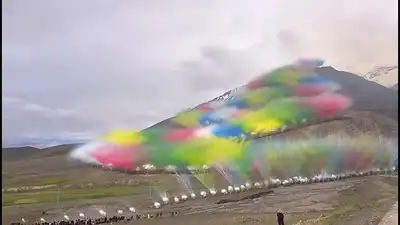
The continued closure followed investigations triggered by a 52-second high-altitude fireworks spectacle near Shigatse, Tibet, earlier and a probe into alleged corruption in issuing permits to foreign expeditions.
NEW DELHI: China has shut the highest mountains of Tibet — including Cho Oyu (8,188m), Shishapangma (8,027m) and the north side of Mt Everest (8,849m) — to foreign climbers for this year, forcing Nepal-based expedition operators to cancel autumn bookings and leaving mountaineers chasing all 14 of the world’s 8,000m-plus peaks facing at least another season of delay. The continued closure followed investigations triggered by a 52-second high-altitude fireworks spectacle near Shigatse, Tibet, earlier and a probe into alleged corruption in issuing permits to foreign expeditions. China issued no Everest permits to foreign climbers during spring, resulting in a record 1,008 summits from the Nepal side.
China-Tibet Mountaineering Association (CTMA) had already kept foreign expeditions off Everest’s north side, Cho Oyu and Shishapangma during the spring season, and expedition organisers in Kathmandu said they have now been informed that foreign teams would not be allowed back for autumn either. Alan Arnette, 69, a reputed mountaineer-blogger from US, quoted a CTMA source as saying high-level officials of CTMA and Tibetan Sports Bureau had been jailed over the controversial fireworks and authorities were also investigating “rampant financial corruption” in the granting of permits to foreign expeditions. Arnette said Tibet has become the “ultimate choke point” for record seekers. If they shut the gate — whether over geopolitics, accidents or local scandals — climbers simply have to pack up and go home,” he said. Another source said four officials in Shigatse were sacked following the fireworks and two senior officials involved in issuing expedition permits were detained last winter on suspicion of corruption.
Beijing has not publicly explained the extended restriction. “You can have the physical ability, the weather window and hundreds of thousands of dollars ready to deploy, but CTMA holds all the cards.
Her May 18 oxygen-free ascent of Lhotse took her to 13 of the 14 8000-ders, all climbed without supplemental oxygen. Qatari royal and mountaineer Sheikha Asma bint Thani Al Thani summited Gasherbrum II in Pakistan on July 30, taking her tally to 11. Mingma Gyalje Sherpa, 39, managing director of Imagine Nepal and a 14-peaks summiteer without supplemental oxygen, told TOI , “Tibet has always been the wildcard in the 14-peaks equation. A Norwegian climber, an Elite Exped client who has completed 12 eight-thousanders, described the frustration of waiting for access despite being ready to climb. “The hardest part of the 14 peaks is not the death zone, technical ice or the weather windows.
Because shishapangma lies entirely inside Tibet, while the normal route on Cho Oyu also approaches from Tibet, the closure has particularly hit climbers chasing all 14 8000-ders. Because a stamp won’t hit a piece of paper,” he told TOI, it is sitting in a hotel room in Kathmandu watching the seasons slip away. Alternative routes on Cho Oyu from Nepal are substantially harder and rarely climbed. German extreme mountaineer Anja Blacha is now one mountain short of completing the set. Only Shishapangma remains, leaving completion dependent on Tibet reopening to foreign climbers. Broad Peak, Cho Oyu and Shishapangma remain. You can have the logistics, the climbers and the weather windows perfectly aligned in Nepal and Pakistan, but if the northern border stays shut, the whole global circuit comes to a standstill. Catch the latest World News and Live updates. Download the TOI app.
On Sept 19, 2025, Canadian outdoor gear brand Arc’teryx and Chinese pyrotechnician Cai Guo-Qiang staged a fireworks artwork titled ‘Ascending Dragon’ in Gyantse county of the Shigatse region, setting off 1,050 fireworks in four sequences at altitudes of roughly 4,670m to 5,020m and creating a golden dragon-like trail across the Himalayan landscape. The display affected around 30 hectares of high-altitude grassland, while reports put the nearest waterbody around 30 metres away and the nearest glacier about 6km from the site.
A source at a Kathmandu-based expedition agency, who did not want to be named, told TOI , “The two senior officials detained last winter were primarily responsible for issuing foreign expedition permits, and the corruption investigation has left the entire process on hold. Cai, director of visual and special effects for the 2008 Beijing Olympics, was behind its famous 29 giant pyrotechnic “footprints” across Beijing. “We are cancelling reservations for Cho Oyu and Shishapangma after the Tibetan authorities conveyed that the Tibetan routes to these mountains would not be open to foreign expeditions,” a Kathmandu-based expedition organiser said.
I don’t see things looking up for next spring either. The episode that preceded the upheaval lasted less than a minute. The Tibet display drew a sharply different response, triggering criticism in China and abroad over the use of pyrotechnics in a fragile alpine ecosystem. Arc’teryx and Cai subsequently apologised, while authorities in Shigatse opened an investigation.