
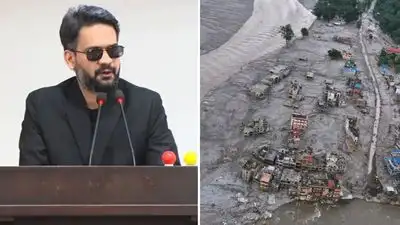
Nepal PM Shah said teams from India and China had expressed interest in helping soon after the disaster.
Nepal Prime Minister Balendra Shah on Wednesday thanked India and China for their swift assistance after devastating flash floods killed over 1,000 people and left nearly 4,900 missing.
New Delhi sent the fifth tranche of relief material on Tuesday, with an Indian Air Force aircraft carrying an 11-member rescue team, specialised equipment and 5.5 tonnes of essential medicines. It is carrying an 11-member rescue team with specialised equipment, and 5.5 tonnes of essential medicines,” external affairs minister S Jaishankar said in a post on X on Tuesday. 348 bodies were recovered from Chitwan, 217 from Nawalparasi East, 190 from Nawalparasi West and 155 from Nuwakot, according to Nepal Police. Another 66 bodies were recovered from Gorkha, 59 from Dhading, 45 from Rasuwa and 38 from Tanahu. Police said postmortem and legal identification procedures had been completed for 1,113 bodies, while 95 bodies had been handed over to relatives. Details of 911 unidentified bodies have been uploaded on the Nepal Police website to help families identify missing relatives. Security forces have rescued 6,541 people from affected areas, while search operations continue for 4,858 people reported missing, police said. Authorities have deployed 7,912 police personnel for search and rescue operations, relief distribution and management of recovered bodies. Earlier reporting noted: Nepal PM Balen Shah thanks India, China for flood aid after his minister’s ‘climate compensation’ pitch Nepal’s Prime Minister Balendra Shah has thanked India, China and the US for their assistance after devastating flash floods hit the country on August 26, saying the support has played an important role in ongoing rescue and relief operations. Earlier reporting noted: Speaking about the disaster, Shah said, “So far, 11,993 people have been rescued. We have not been able to establish contact with at least 3,916 people.
Because of difficult ground conditions, foreign teams initially conducted aerial assessments but were unable to land. Because of climate change, shah also claimed that the scale of the disaster had raised serious questions about the growing risks faced by people in the Himalayan region.
Addressing the House of Representatives, Shah said the government had been coordinating with the international community from the beginning and had sought to expedite procedures to receive assistance. Teams from India and China expressed interest in helping soon after the disaster, he said, according to The Kathmandu Post. “According to experts, the flash flood in Bhotekoshi of Rasuwa district was caused by an ice-rock avalanche in the Himalayas. This incident shows the increasing risk the people of the mountain region have to bear with the occurrence of climate change,” he said. “Therefore,” Shah stressed, “We need to present the fact in a strong manner to the international community that the disaster is linked to climate change. Earlier in the day, foreign minister Shisir Khanal called for greater international accountability, saying Nepal contributes “virtually negligible” greenhouse gas emissions but is bearing a disproportionate share of the consequences of climate change. The rapid melting of glaciers and these catastrophic mountain tsunamis are direct consequences of global climate change,” Khanal said in an interview with Kantipur TV, excerpts of which were published by The Kathmandu Post. Khanal said Nepal was shifting its diplomatic approach from seeking “aid” to demanding “justice and compensation”. “This is not a matter of charity; it is a matter of legal and moral liability,” he said, adding that Nepal would raise the issue “with absolute firmness and clarity” at international forums. Khanal identified China, the US and India as the world’s three largest greenhouse gas emitters and said they had a “historical responsibility to compensate vulnerable nations like Nepal”, according to news agency PTI. We are advocating not just for Nepal, but for the survival of South Asian civilisation,” he said.
They later reached the affected areas once helicopters could operate safely and heavy equipment could be deployed, he added. India has provided both relief supplies and specialised assistance to Nepal. “The fifth Indian aircraft has departed for Nepal. Indian teams have also been assisting with search and rescue operations around hydropower tunnels and supporting forensic work to identify victims amid the large number of casualties and missing people. “There is a global contribution behind climate change. And the responsibility to manage and minimise its effects also rests with the global community,” the prime minister added. “We are paying the ultimate price for a global crisis we did not create. “This is a matter of civilisational survival. If our Himalayan glaciers disappear, the water security of over two billion people in South Asia dependent on rivers like the Ganges and the Trishuli will be permanently compromised. Rescue teams are also relocating families from high-risk areas, clearing debris from roads and coordinating relief operations with local authorities and residents. However, continuing rain has disrupted search and rescue efforts in Rasuwa and Nuwakot. Catch the latest World News and Live updates. Download the TOI app. The next day, a group of ministers travelled to the affected areas. In these difficult times, we got support from various countries, including India, China, the US, and others. We got support from various banks.
Earlier reporting noted: Shah thanks India in Parliament Shah thanks India in Parliament Earlier on Wednesday, health minister Nisha Mehta said India was assisting Nepal in managing the bodies of those killed in the floods, including through DNA testing and support for establishing a laboratory for DNA management.
The death toll from the devastating flash floods rose to 1,127 on Wednesday, with nearly 4,900 people still missing, as rescue teams battled continuing rain and debris. The floods, triggered by an ice-rock avalanche near the Nepal-Tibet border on August 26, devastated towns and villages across northern and central Nepal. A letter jointly signed by finance minister Swarnim Wagle and forests and agriculture minister Geeta Chaudhary said the disaster had caused extensive economic and non-economic losses beyond Nepal’s immediate response capacity.
Nepal has formally approached the Fund for Responding to Loss and Damage, seeking urgent financial assistance following the Bhotekoshi River basin flash flood.