.
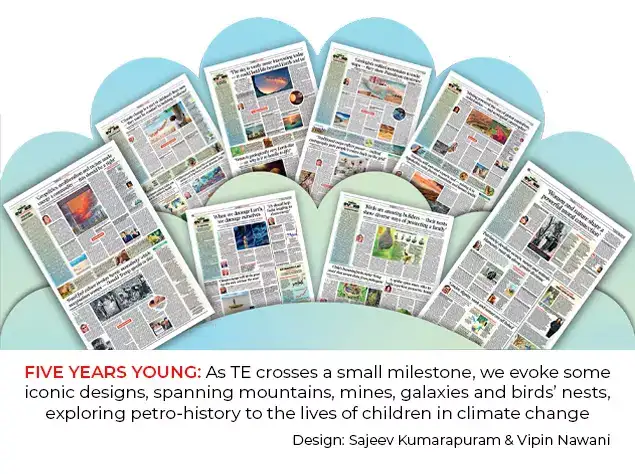
Even as we greet 2026, we are reminded of how ‘TE’ began exactly five years ago. In 2020, the world had already crossed 1.25 degrees above pre-industrial levels, causing ancient ice to melt and sea levels to rise, altered winds and changing tides bringing typhoons and droughts worldwide. As these economies steamed and spewed forth, temperature-raising emi-ssions were released into Earth’s atmosphere. Won’t the planet feel strange without its singing whales and humming bees?
‘You will highlight the environment,’ we were told, ‘Who will read this? Happy new year, dear reader — and happy anniversary! The world we stepped into held both astonishments — and banalities. One of these (you decide which) was an oft-repeated assertion, that readers only cared about politics, sports and movies. Our founding vision was crystal-clear — Earth’s vital signs showed a planetary crisis unfolding. There were two dimensions to this human-driven ‘Anthropocene’. The first was geophysical turmoil, manifest in global temperature increase. The other was a biodiversity crisis — one million plant and animal species faced extinction, driven to life’s edge by climate change, pollution and habitat loss. Through all this, The Times of India steadfastly reached you — and you reached back. The ‘TE’ which you named, dear reader, got communiques from far and wide. Your letters reflected a passion for science — every TE feature, from exploring outer space to delving into a cauliflower’s Fibonacci sequence, tracing the magnetic arcs of migrating birds to the geometrical symmetry of a leaf — was appre-ciated. You wrote back with irrefutable logic and made us think deeper — why, when climate data was known, was the world hurtling faster towards catastrophe? We began to explore the social backdrop to your questions and found how our ways of life, from a cup of tea to petro-energy, meant earthly extraction. First, this was forced labour, seeking opium to opals — the profits of such colonialism then powered industrialisation in some nations. Climate change was thus caused by a handful of nations — but it is felt by all. The violence of these extractions is marginalised — or normalised even as they make Earth abnormal. These facts have been explained to TE by the world’s most distinguished minds. Demo-cratising access to cutting-edge global expertise, TE brings scholars, artists and naturalists from London, Lisbon, Louisiana, Lima and Lome home every week. Your letters keep suggesting new themes — what about climate justice? How will children live with pollution? Will oil imperialism ever end — or will it end Earth? These are hard problems — with solutions. Renewable energy is one hopeful way forward — another is seeking ecological accountability. It is no coincidence that some of the biggest news stories of our times — from protecting stray animals to protesting high AQI — draw from a growing sense of environmental reciprocity.
Today, thousands of letters later, that question has been answered. Today, it is driven by vast industries, diamond mines to sugar crops, peaks of plastic to conquests for oil.