
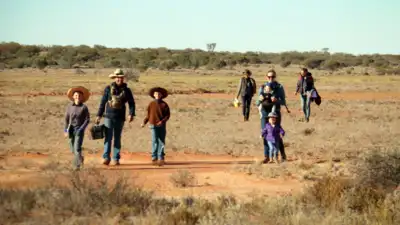
Alongside updates from the University of New South Wales (UNSW) and the NSW Government, the couple’s work through the Wild Deserts project has helped reintroduce six native mammal species to Sturt National Park, according to a September 2026 report by ABC Landline journalist Bill Ormonde. What began as an ambitious conservation experiment in one of Australia’s most isolated landscapes has grown into a remarkable wildlife recovery effort. Nearly a decade after moving to a remote station in north-western New South Wales, ecologists Rebecca West and Reece Pedler are witnessing the return of native mammals that had disappeared from the region for morqe than a century. More significantly, some of these animals are now breeding and establishing populations beyond the project’s predator-proof enclosures.
To work towards that goal, the team established a 100-square-kilometre Wild Training Zone surrounding the protected enclosures. By September 2026, researchers had recorded survival, breeding and the arrival of new individuals among populations of bilbies, bettongs, golden bandicoots and western quolls released beyond the fences. The project had also established the largest rabbit-free area of its kind, covering approximately 4,000 hectares.
Here, feral cat populations are kept at lower levels, allowing reintroduced animals to gradually adapt to living alongside predators. The approach is showing encouraging results.
The progress has been significant enough for the NSW Government and UNSW to extend their partnership for another 10 years, announced in June 2026. The next phase will focus on improving predator management, monitoring animal populations and finding ways to expand successful reintroductions across larger landscapes. For West and Pedler, the transformation of Sturt National Park represents more than the return of individual species. It is an attempt to rebuild an ecosystem in which native animals, vegetation and natural processes can once again support one another. After years of research, predator control and carefully monitored releases, the desert is showing signs of life that had been missing for generations.