
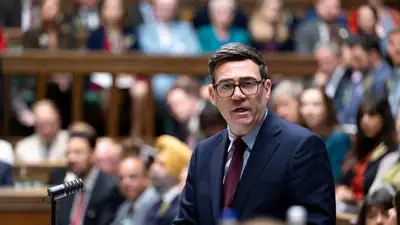
File photo: Britain’s Prime Minister Andy Burnham
On June 23, 2016, Britain voted by 52% to 48% to leave the EU. Nine months later, Theresa May triggered Article 50, formally beginning the process of withdrawal. The research found that immigration and perceptions of lost control hardened Eurosceptic attitudes. British businesses now face customs procedures, rules-of-origin requirements and additional regulatory paperwork, while services companies lost some of the market access they had enjoyed as part of the EU.
British prime minister Andy Burnham has reopened one of the country’s most divisive political questions, saying Brexit has done “more harm than good” and signalling that Britain could consider everything from a closer relationship with the European Union to eventually rejoining the bloc. Speaking at the Labour Party conference, Burnham said the UK’s current relationship with Europe was not “good enough” and promised to set out different options around a UK-EU summit later this year. Asked directly whether Britain should rejoin the EU, he said he wanted to “look at the options”, ranging from staying as it is to considering a customs union, the single market or going “all the way”. The comments mark a significant shift from the position Labour took at the 2024 election, when it promised to “make Brexit work” while ruling out rejoining the EU’s customs union or single market. Burnham had also previously said he did not want to “re-run” the Brexit argument.
Immigration was another major factor. The refugee and migration flows that followed upheaval in the Middle East and North Africa, particularly after the Arab Spring, intensified concerns about whether Britain and the EU could control migration. But Brexit was not simply a change in Britain’s political relationship with Europe. It altered the economic framework through which Britain traded with its largest nearby market. The post-Brexit Trade and Cooperation Agreement removed tariffs on most goods trade but did not preserve the UK’s previous access to the EU single market and customs union. Free movement also ended.
The 2008 financial crisis and its aftermath also shaped the political mood. The decision was not driven by one issue alone. Research by Professor Paul Whiteley and colleagues, using more than a decade of survey data, found that attitudes towards EU membership were closely tied to whether voters felt it was delivering on issues including economic prosperity, control over immigration, public services, crime and terrorism. The research found that Britain’s slow recovery left sections of the electorate feeling economically dissatisfied and politically unrepresented.
How did Brexit impact Britain?
Because the post-Brexit agreement provides less access than single-market membership, services have proved more resilient, particularly Britain’s high-value digital sectors, but regulated industries such as financial and legal services have faced new barriers. Because it affects the capital available to businesses and, ultimately, productivity, lower investment matters. As a result, the overall migration story became one of composition rather than a straightforward fall in numbers. Because he has framed Britain’s future relationship with Europe partly around immigration and economic control, that is particularly relevant to Burnham’s comments.
Industries including hospitality, agriculture, logistics, food processing and manufacturing lost access to a familiar pool of European workers. Burnham has not announced that Britain will rejoin the EU but is reconsidering a position Labour had previously rejected.
Immigration was at the heart of the Brexit debate, but the post-Brexit picture turned out to be more complicated than simply “less immigration”. His conference speech said the current settlement had failed to provide sufficient control over either area. He said Britain could remain where it is, consider a customs union, consider the single market or “go all the way” back into the EU, while stressing that the options would need to be examined for what is actually doable and what their pros and cons would be.
Trade has been one of the clearest areas of change. British firms trading with the EU have had to absorb additional paperwork and regulatory costs. The result has been a decline in the number of firms exporting to the EU even where overall trade figures appear relatively resilient. Leaving the EU ended free movement and sharply reduced EU migration. Businesses responded in different ways, including through higher prices, lower output and changes to their operating models. At the same time, non-EU migration increased through work and study routes. The immediate agenda is more modest; Burnham has already pointed to closer cooperation with Europe on immigration and measures to help British industries affected by Brexit. He plans to use the delayed UK-EU summit later this year to lay out longer-term options and seek consensus around one of them. Labour’s previous approach was essentially to accept Brexit and make the existing settlement work better. Burnham is now questioning whether the settlement itself is good enough. You use AI every day. Now get your AI Quotient. Take the AIQ test.
Brexit also created uncertainty for companies that had previously used Britain as a base for accessing European markets.