
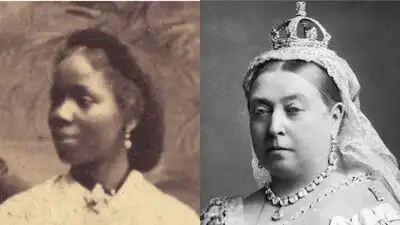
Sarah Forbes Bonetta (L), Queen Victoria
A seven-year-old African girl who was presented to Queen Victoria as a ‘gift’ in 1850 went on to become one of the best-known African women in Victorian Britain. Now, 176 years later, a newly published biography examines the life of Sarah Forbes Bonetta, while her great-great-grandson, Bayo Randle, reflects on what her experiences meant for his family. Randle, a 37-year-old British-Nigerian barrister living in London, discussed his ancestor’s story in an interview with The Guardian. Lovejoy has also examined how more than 700,000 Africans freed from enslavement were subjected to arrangements requiring them to work for years to cover the supposed cost of their freedom and argues that Bonetta occupied a privileged position within this broader system. Long before she met Queen Victoria, Bonetta was a child named Aina, born in 1843 in Oke-Odan, in present-day southwest Nigeria. In 1848, forces belonging to King Ghezo of Dahomey attacked her town. Her circumstances changed when Frederick Forbes, a captain in the Royal Navy’s West Africa Squadron, travelled to Dahomey in 1850. She met Queen Victoria at Windsor Castle on November 9, 1850. At 19, she married James Pinson Labulo Davies, a wealthy merchant and philanthropist from Sierra Leone. Their wedding took place on August 14, 1862, with Queen Victoria’s approval. They had three children, including their eldest daughter, Victoria, born in 1863 and named after the queen. She travelled to Madeira, hoping the climate would improve her condition, but died there on August 15, 1880, aged 37. During his research, Lovejoy located a plaster bust of Bonetta made in 1851 by sculptor Benedetto Pistrucci.
“I don’t think a human being, who has agency, could be ‘gifted’ from one to another, but had she not been gifted to Queen Victoria, would I be here today?” he asked. British naval captain Frederick Forbes, who brought the girl to England, had requested that she become “the property of the crown”, according to Lovejoy’s research. The historian argues that Bonetta was “effectively indentured to Queen Victoria until age 19”. Although she received an education and enjoyed connections unavailable to many others, her position was shaped by a system that continued to restrict African people’s freedom even after the abolition of slavery, according to the research. Her achievements were used to support British claims about the benefits of colonial rule in Africa, according to the historian. It remains unclear whether Ghezo offered her freely or Forbes negotiated for her release, according to English Heritage.
But behind her royal connections was a childhood marked by violence, separation from her family, and decisions made largely by others. The biography, Becoming Sarah Forbes Bonetta: A Yoruba Woman in Queen Victoria’s Court, has been written by Professor Henry Lovejoy of the University of Colorado Boulder. It looks beyond Bonetta’s association with the British royal family to examine the circumstances in which she was brought to England, the restrictions placed on her, and the life she eventually built. During the interview, Randle questioned the idea that a person could be given away as a diplomatic present, while acknowledging that the event had changed the course of his family’s history. For much of her life, Bonetta was known for her unusual position in British society. Queen Victoria paid for her education, maintained contact with her, and later approved her marriage. She also became godmother to Bonetta’s eldest daughter. However, the new biography questions whether this privileged upbringing meant that Bonetta was free to make her own choices. This finding places her experience in a different light. Her family was killed, and she was captured at approximately five years old. She remained at the king’s court for the next two years. He had been sent to persuade King Ghezo to agree to measures against the slave trade. The diplomatic mission did not achieve its intended result, but Forbes returned with the young girl. Before taking her to Britain, Forbes arranged for her baptism and gave her the name Sarah Forbes Bonetta, using his surname and the name of his ship. The queen subsequently arranged for her care and education. Bonetta spent time with the Forbes family, attended a missionary school in Sierra Leone and later lived with families in England. Her abilities in languages and music attracted attention, and she became a familiar name in British newspapers. Despite her close association with the royal family, Bonetta did not spend most of her adult life in England. But Bonetta had expressed doubts about marrying Davies. In correspondence with Mrs Schoen, whose family had cared for her in England, she questioned whether financial independence was a sufficient reason to accept a marriage. The couple subsequently moved to Africa, living in Sierra Leone and Lagos. Bonetta became known for her accomplishments as a linguist, musician, travel writer and educator. Her life in Lagos was an important part of her story, although it has often received less attention than her childhood connection to the British monarchy. Her later years were affected by tuberculosis. Following her death, Queen Victoria continued to support her daughter Victoria, including helping with her education. He first learned about Bonetta from his father, Adekunle Randle, a retired lawyer. His family still possesses an engraved goblet and plate given by Queen Victoria to Bonetta’s daughter. One discovery was particularly significant. Randle subsequently saw the work, which preserves the appearance of his ancestor as a young girl. But the sculpture also reflected the racial attitudes of its time. It had been produced for purposes connected to phrenology, a discredited practice that attempted to draw conclusions about people’s characteristics from the shape of their skulls. The biography also disputes several longstanding descriptions of Bonetta, including claims that she was a Yoruba princess and that she herself was Queen Victoria’s goddaughter.
For Randle, the biography has also brought him closer to parts of his family history that were previously difficult to examine.
“But it would be a mistake to paint her story as entirely tragic,” he told The Guardian. Randle has welcomed these findings, even when they challenge more familiar versions of his ancestor’s life. He believes understanding her experiences requires recognising both the opportunities she received and the control others exercised over her. He also does not want Bonetta to be remembered only for what happened to her as a child. Her education, abilities and achievements in Africa, he believes, deserve attention alongside the circumstances that brought her to Britain. For Randle, the new biography is an opportunity to understand Bonetta as more than a girl once presented to a queen. You use AI every day. Now get your AI Quotient. Take the AIQ test.