
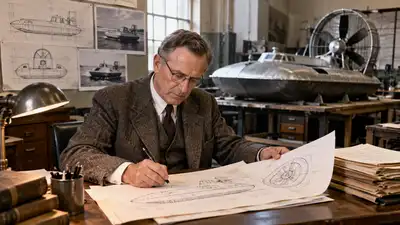
Image AI generated
In 1955, British engineer Christopher Cockerell was testing an idea that would transform amphibious transport, using equipment that looked more suited to a kitchen than an engineering workshop. Image AI generated According to Made up in Britain, Cockerell established Ripplecraft to develop the concept and eventually persuaded the Ministry of Supply to support the project in 1955. In 1958 the National Research Development Corporation ordered Saunders-Roe Limited to construct a full-scale hovercraft prototype. The resulting vehicle, the SR.N1, could carry up to four people at a speed of 28 miles per hour (45.1 kilometres per hour). It was formally introduced to the public on 11 June 1959. The SR.N1 as the world’s first man-carrying amphibious hovercraft and says Saunders Roe developed the 20-foot craft under Cockerell’s guidance. After being shipped to France in July 1959, it successfully crossed the English Channel between Calais and Dover.
What began with an improvised arrangement of tins and a vacuum-cleaner fan had therefore progressed into a man-carrying amphibious craft and a new means of transportation.
As per the American Association of State Highway and Transportation Officials, he theorised that air could be channelled around the vessel to create what he called a “momentum curtain”, allowing an amphibious craft to be lifted completely out of the water. The military establishment was initially difficult to convince, with Cockerell recalling: “The Admiralty said it was a plane and not a boat, the Royal Air Force said it was a boat and not a plane, the Army were plain not interested. His early experiment involved two tin cans, a vacuum-cleaner fan and, an empty cat-food tin placed inside a coffee tin. Cockerell was trying to prove that a cushion of air could lift a vessel clear of the water and reduce drag. The experiment helped demonstrate the principle behind the hovercraft, leading to his first patent and, eventually, the development of the SR.N1, the first man-carrying amphibious hovercraft. Cockerell’s interest in the idea developed after he left Marconi and bought a small boat and caravan hire business, later named Ripplecraft. He began considering how vessels could move faster and realised that a craft lifted clear of the water would no longer experience the same drag. The Made up in Britain account similarly explains that Cockerell’s design sought to make a vehicle move over both land and water while floating on a layer of air. His experiments eventually led him to use a modified punt equipped with a pump that forced high-pressure air beneath and around its rim. A strong rubber curtain helped retain much of the air, producing the lift needed to support the craft. His invention nevertheless continued towards full-scale development. Cockerell’s patent and continued development eventually attracted government-backed support. The project demonstrated that the principle first tested with a pair of tins and a vacuum-cleaner fan could be developed into a full-sized vehicle capable of travelling across different surfaces. The same year the NRDC established a subsidiary called Hovercraft Development and appointed Cockerell as its technical director. Cockerell continued improving the hovercraft and exploring other applications of the air-cushion principle. Catch the latest World News and Live updates. Download the TOI app.
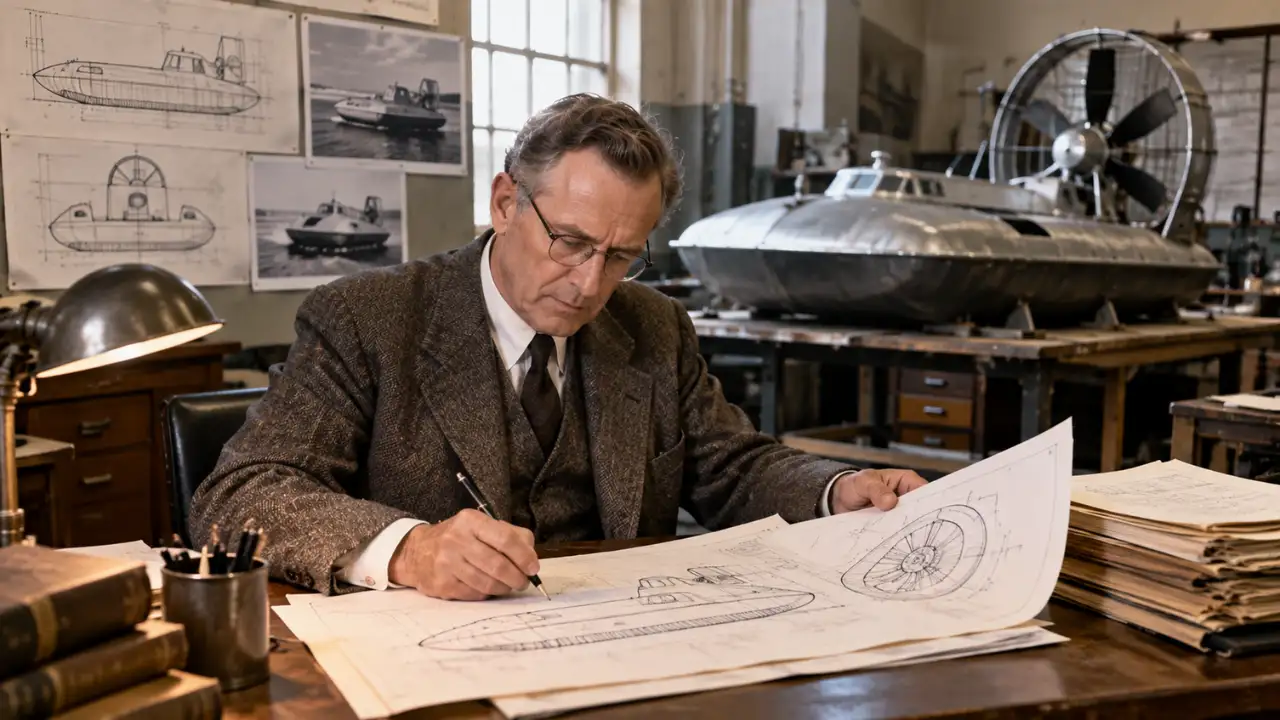
Transportation History states that Cockerell’s experiments resulted in a workable version by 1955, when he “filed his first patent for it.” The significance of the small-scale experiment was that it gave Cockerell evidence that his air-cushion theory could work in practice. Rather than relying on conventional contact between a vessel and water, the concept used air to create a cushion beneath the craft.