
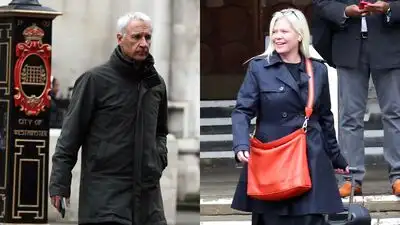
(L)Jeremy Cowdrey; (R) Vanessa Gibson. Image Credits: Champion News/The Independent
Jeremy Cowdrey, son of former England cricket captain Colin Cowdrey , has won a costly legal battle with his neighbour after a dispute over a strip of land disrupted the sale of his £3.85 million country home in Kent. The dispute centred on Crowbourne Farm, a substantial country property in Goudhurst, Kent, bought by Jeremy Cowdrey in early 2022. As reported by The Independent in February 2025, the Grade II-listed farmhouse sits within more than 10 acres and includes a guest cottage, studio, barn, workshop, wine cellar, stables, woodland and two lakes, alongside a tennis court.
Because of the way she had conducted the litigation, cowdrey’s barrister argued that Gibson should bear the substantial legal costs. The Independent reported that Cowdrey eventually agreed to fence off the disputed section and relinquish any claim to it. The disagreement, which began when Vanessa Gibson acquired land containing part of his private tennis court, escalated into a court case involving allegations of harassment, malicious falsehood and attempts to extract money. A judge ruled in Cowdrey’s favour, awarding him compensation and ordering Gibson to pay a substantial contribution towards his legal costs. Cowdrey’s disagreement with Vanessa Gibson, who lives in a nearby barn conversion, began after she bought a strip of land that included part of his tennis court. Gibson argued that the court extended onto land she owned, creating a boundary dispute between the neighbours. The arrangement was intended to settle the disagreement, but the relationship between the two neighbours deteriorated further as Cowdrey attempted to sell the property. The judge ordered a significant portion of the costs to be assessed on an indemnity basis, a more demanding approach to costs recovery. Join conversation Share your thoughts in the comments Be respectful · TOI community guidelines
Cowdrey put Crowbourne Farm on the market in June 2023, initially advertising it for more than £3.25 million. He claimed that several prospective buyers had been discouraged by Gibson’s correspondence and that he had agreed a £3.85 million sale with a couple before they withdrew, according to The Independent. The Independent reported in November 2025 that the judge found Gibson’s conduct had gone beyond protecting her own interests. The judge said Gibson’s actions between March 2022 and June 2023 were motivated by an improper purpose, specifically causing financial loss by preventing Cowdrey from selling Crowbourne Farm unless he paid the amount she wanted. Cowdrey had sought damages after the agreed £3.85 million sale collapsed. He argued that the property would have been worth around £3.7 million without Gibson’s allegations and claimed the difference between that figure and the failed sale price. Judge Evans-Gordon awarded him £150,000, together with interest, for the financial loss associated with the failed transaction. She also gave £9,000 in damages for the oppressive and unreasonable harassment he had experienced. The total compensation came to approximately £159,000 before interest. The Independent reported in November 2025 that Gibson had been ordered to pay £360,000 towards Cowdrey’s legal expenses, including VAT, as an initial payment before the full costs were assessed. That amount was on top of the £159,000 compensation award. Together, the sums brought the immediate financial order to roughly £519,000, explaining reports that Cowdrey had won around £500,000 from his neighbour.
The Standard reported that Cowdrey believed his neighbour was making allegations in an attempt to extract money from him while he was trying to sell the estate.
Gibson told the court she did not have the money to pay the bill, according to The Independent. They also accused her of raising concerns about restrictive covenants, flooding and the property’s utility connections. At a preliminary hearing, his barrister argued that the correspondence was designed to jeopardise the transaction and pressure him into paying her. Gibson disputed the allegations. She maintained that her concerns were legitimate and related to the land she owned, including flooding that affected both properties. The case proceeded to Central London County Court, where Judge Jane Evans-Gordon considered Cowdrey’s claims of malicious falsehood and harassment. Her claims about continuing disagreements involving the tennis court, utility services and land covenants were found to be false. The judge considered that Gibson had concealed her purchase of the strip of land until she could use ownership to seek significant payment. the court found that her conduct had crossed the line into a form of blackmail or maliciousness While she was entitled to protect her interests. The financial consequences grew further when the parties returned to court over legal costs.
His legal team alleged that Gibson continued to present the boundary issue as unresolved, despite the earlier agreement. The court decided that the earlier boundary dispute had been settled and that Gibson had attempted to conceal her intention to interfere with the sale.
What restrictions were placed on future contact
The November 2025 hearing also addressed how the neighbours would communicate in future. The Independent reported that she explained such a breach could carry a fine or imprisonment of up to 2 years. Gibson gave legally binding undertakings setting out how and when she could contact Cowdrey. Judge Evans-Gordon warned that breaching those commitments could amount to contempt of court. You use AI every day. Now get your AI Quotient. Take the AIQ test.