
PC: BBC
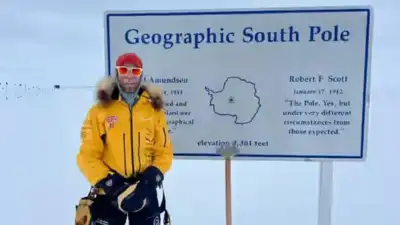
A stroke at the age of 28 left former British Army officer Jonny Huntington paralysed from the neck down on his left side, forcing him to spend years rebuilding his ability to walk. The 38-year-old covered 911km of Antarctic ice in 46 days, overcoming freezing temperatures, difficult snow conditions and the lasting effects of his stroke.
He told the BBC: “It’s been a bit of a whirlwind since getting here. Reflecting on how he managed to complete the challenge, he said: “On this trip, I kept putting one foot in front of the other until I got to the end. ” He added: “When things were really tough, I just refused to stop putting one foot in front of the other. Following his achievement, Huntington said he was looking forward to celebrating with a steak and a glass of red wine.
However, the life-changing injury did not end his sporting ambitions. After discovering para-skiing during his recovery and spending five years preparing for an ambitious expedition, Huntington became the first disabled person to ski solo and unsupported to the South Pole. Speaking via satellite phone after arriving, Huntington described the experience as emotional. It’s pretty emotional. He also acknowledged the physical toll on his right leg, which had performed most of the work during the expedition. You use AI every day. Now get your AI Quotient. Take the AIQ test.
How a massive stroke changed his life before the South Pole expedition
However, his life changed dramatically when he suffered a stroke at the age of 28. He subsequently joined the Great Britain para Nordic ski team, competing internationally between 2017 and 2020. He also participated in the inaugural European Paralympic Committee Games in Poland in 2020. Huntington’s expedition required him to cover 566 miles (911km) of Antarctic ice while pulling a 242lb (110kg) sledge containing his food and equipment. He began the journey on 21 November 2024 and had to ski for approximately nine to 11 hours every day. The conditions included freezing temperatures and 24-hour sunlight, making the expedition physically demanding throughout its 46 days. On Monday, 6 January 2025, Huntington reached the geographical South Pole after 46 days on the ice. At the time of his achievement, only 52 people had successfully skied to the South Pole without support, placing his expedition among a small number of such journeys.
Because of huge ice formations known as sastrugi and patches of soft snow, both of which made forward progress harder, the final stages presented additional difficulties. The BBC reported that the incident left him paralysed from the neck down on his left side. His recovery eventually introduced him to adaptive skiing, providing an opportunity to pursue competitive sport despite his disability. Joining the team ignited his love for skiing and introduced him to a sport that would eventually shape his future ambitions, according to the BBC. He also revealed that, towards the end of the expedition, he had become concerned about whether his stronger right side would withstand the strain.
Speaking about the difficulties, Huntington told the BBC: “This has been tough, the injury has certainly made it more difficult. He became the first disabled person understood to have completed a solo and unsupported ski journey to the destination, according to the BBC. Before his Antarctic achievement, Huntington had served as an officer in the British Army. The resulting physical limitations meant he had to undergo years of rehabilitation to regain his ability to walk. he continued to experience restricted movement down his left side Although he eventually recovered enough to walk independently. The stroke also had a lasting impact on his physical capabilities, making the prospect of undertaking an expedition across Antarctica particularly challenging. Huntington had to adapt to life with the effects of the injury and gradually rebuild his physical strength. The experience would later become an important part of his preparation for the South Pole expedition. During his stroke recovery, Huntington became a member of the Armed Forces Para-Snowsport Team (AFPST). His competitive career included World Cup events in Lviv, Ukraine, and Vuokatti, Finland. After eventually stopping competitive skiing, Huntington began considering a different challenge: travelling alone and without support to the geographical South Pole. He spent five years planning and training for the expedition before setting off for Antarctica. His stroke-related disability also affected his ability to manage the physical demands of the journey.