
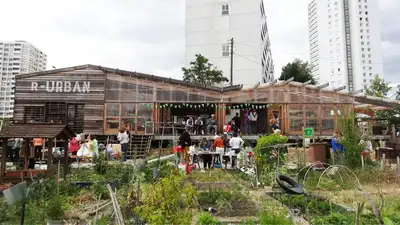
R-Urban Poplar, an ecology hub in east London, features community growing spaces, workshops and gardens on the Teviot Estate. (Image: R-Urban Poplar)
The sauna remains in its testing phase, with full operation expected later in 2026. Since 2017, the site has transformed a disused car park and vacant garages into a community space focused on food, ecology and circular systems. MAD LEAP has said the scheme could initially manage around a quarter of the food waste generated by the 535-household Teviot Estate.
That figure represents the project’s intended capacity rather than a confirmed amount currently being processed each week.
Project partner MAD LEAP says the system is intended to produce bioenergy for uses including cooking, hot water and the community sauna. MAD LEAP says the pilot is designed to manage about 900kg of food waste a week when combined with existing composting infrastructure. A community project in east London is testing an unusual way of turning household food waste into energy. At R-Urban Poplar, an ecology hub on the Teviot Estate, food scraps collected from nearby residents are processed through a community-scale anaerobic digester to produce biogas. The gas can then be used to power a community sauna at the site. Project organisers describe it as the world’s first community-powered sauna of its kind, although the claim has not been independently established. The experiment is part of a wider effort to create a local circular system linking food waste, energy production and urban food growing. The system at R-Urban Poplar is designed to keep food waste within the local area rather than sending it elsewhere for treatment. Residents of the nearby Teviot Estate can participate in a pilot food-waste collection scheme, with the scraps taken to an anaerobic digester at the R-Urban site. Anaerobic digestion breaks down organic material without oxygen and produces biogas along with nutrient-rich digestate. The biogas can be used as an energy source, while the resulting material can support local food growing. R-Urban Poplar is much more than a sauna project. The site includes allotments for local families, communal food-growing areas, a community kitchen and classroom, a workshop and tool library, workspaces and a small commercial mushroom-growing operation. The site also has infrastructure for processing organic waste, allowing the project to connect food production with waste management and energy generation. The project is designed around a simple circular model. Food scraps collected from the surrounding community are sent to the anaerobic digester, where microorganisms break down the organic material and generate biogas. The gas can then be used as an energy source, while the remaining digestate can provide nutrients for local growing. This creates a system in which waste from the neighbourhood can become a resource for activities taking place in the same area. The food-waste system is intended to reduce the need to transport organic waste away from the neighbourhood while returning nutrients and energy to local projects. If the pilot proves successful, the organisation hopes to expand the system and potentially handle a much larger share of the estate’s food waste. The approach is part of a broader experiment in local circular food systems, where food production, waste management and energy generation are connected rather than treated as separate activities.