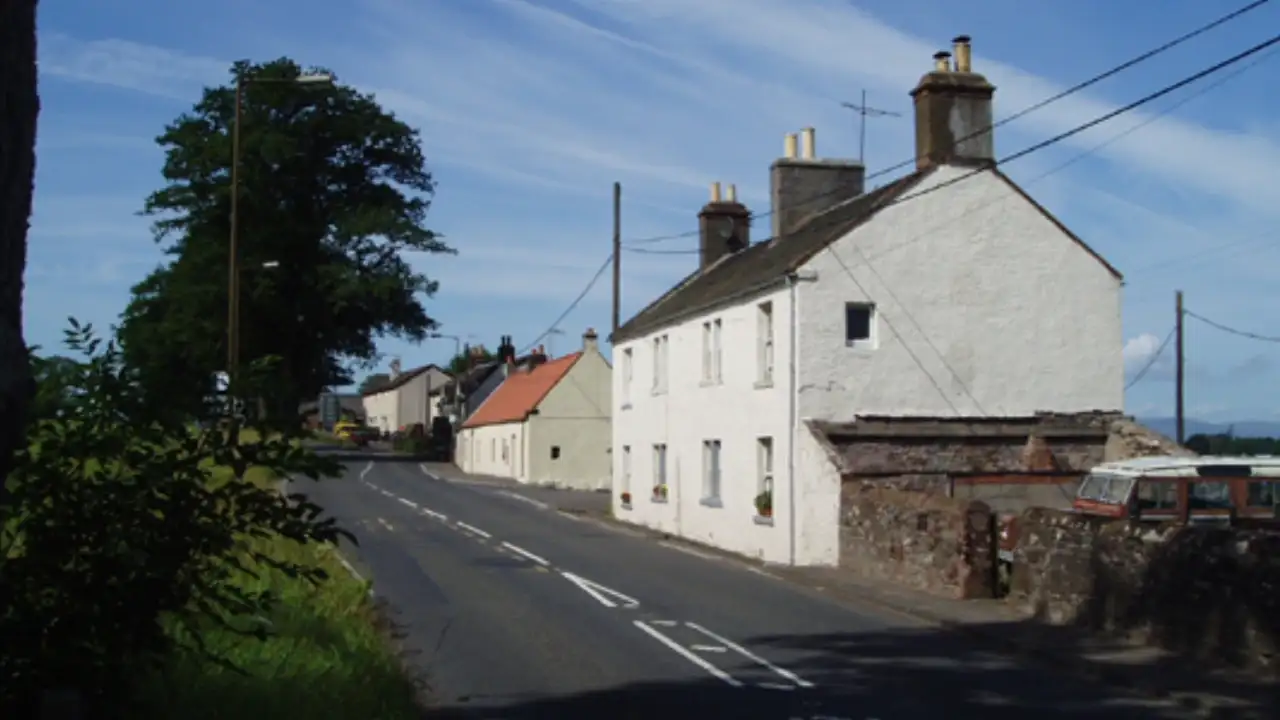
Main Street, Kippen. Image credits: Wikimedia Commons
Ostro Passivhaus was a joint winner in the Residential New Build category at the 2023 UK Passivhaus Awards, according to Paper Igloo’s project page. The practice’s recognition page also lists a commendation at the 2021 Saltire Society Housing Design Awards and wins in the Best Green Home and Home of the Future categories at the 2021 Daily Telegraph Homebuilding & Renovating Awards. The page claims that it complies with the Gold standard of section 7 (Sustainability) of Scottish Technical Standards. The RIAS practice page lists a contract value of £250,000, which is a recorded figure and not necessarily the final total cost of the self-build. It lists the size as a 132 square metre footprint and gives 2020 as the completion year. In June 2022, RIAS announced eight winners of its national architecture awards, and Ostro Passivhaus was one of them. Its practice page lists further 2022 results, including the Scottish Design Awards Chairman’s Award in architecture, the residential prize from the same awards, and an honorable mention in the ASBP Awards. Paper Igloo’s official project page confirms that Ostro Passivhaus was a joint winner in the Residential New Build category at the 2023 UK Passivhaus Awards. Paper Igloo’s official recognition page lists a commendation for Ostro Passivhaus at the 2021 Saltire Society Housing Design Awards, as well as wins in the Best Green Home and Home of the Future categories at the 2021 Daily Telegraph Homebuilding & Renovating Awards.
Paper Igloo also won the RIAS Circular Economy Design Award, sponsored by Zero Waste Scotland, in the same month.
The RIBA award entry says the owners spent four summers cutting and installing the exterior cladding, one summer for each side of the house. Grand Designs Magazine says the name Ostro comes from the southerly wind in the Adriatic. It describes a south-facing, double-height house clad in Siberian larch and built as a timber “box in a box” with a continuous thermal break of wood fiber insulation. The magazine says the cube recalls the entrance to Charles Rennie Mackintosh’s Hill House. In its award announcement, the Royal Incorporation of Architects in Scotland said the owners built the house by hand over several years on a modest budget.
Kippen is a conservation village in Stirlingshire, Scotland, a short drive from Stirling. Its streets are lined with older stone houses, and new buildings there are closely watched. A modern timber house on a plot behind existing homes has to fit in without copying its neighbors. Passivhaus is a voluntary building standard that emphasizes low energy consumption through heavy insulation and airtightness with controlled ventilation. The certification is given after an independent verification of both the design and the completed building. It is uncommon for architects to build their own Passivhaus home for their family, let alone do the work themselves. The house sits in the Kippen conservation area on a backland site reached by a shared driveway. A central two-story black timber cube holds the service spaces. It includes drawers built into the stairs and a gin store beside the kitchen worktop. The judges described it as an exemplary low-energy home that disproves the idea that fine contemporary architecture cannot also be environmentally beneficial. They added that nothing in it is unnecessary and that every part contributes to the building’s story.