
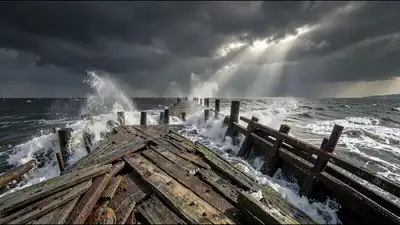
Representative Image of Brighton’s crumbling West Pier battered by stormy seas and strong winds, symbolizing decay and resilience (AI-generated image)
Two men died after trees fell during Storm Boelo on Sunday, October 25. One was a 60-year-old man in Dumfries and Galloway, Scotland. The Energy Networks Association reported that 838,700 UK properties had been affected by power cuts across Storms Austen and Boelo combined. Network Rail warned of major disruption to rail journeys in northwest England on Sunday, October 25, after heavy rain flooded tracks and strong winds brought down overhead power lines in several locations. Research published in Nature Communications in 2018 examined climate-related risks to 49 cultural World Heritage sites in the Mediterranean region. The study found that 37 sites were exposed to flood risk and 42 to coastal erosion, using the base year 2000 for its assessment. Under the study’s high-end sea-level-rise scenario, defined by the 95th percentile of Representative Concentration Pathway 8.5 (RCP8.5), the regional mean flood-risk index rose from 3.7 to 5.5, an increase of almost 50%. The regional mean coastal-erosion risk index increased by 13% by 2100 under the same scenario.
The other was a man in his 20s who died after a tree struck his car in north London, according to reports. The storms also disrupted electricity supplies and transport. The successive storms highlighted how high winds and heavy rainfall can affect infrastructure, transport networks and historic sites in different parts of the country. For coastal structures such as the West Pier, the effects of severe weather add to damage accumulated over many years. The research did not examine Brighton’s West Pier, and its figures should not be applied directly to the structure. It nevertheless provides wider context for the risks facing coastal heritage sites as sea levels rise and erosion continues. Individual sites face different combinations of exposure, structural condition, historical damage and available resources for conservation. For the West Pier, the immediate issue remains the management of a historic ruin that continues to deteriorate. The Trust advises visitors to keep away from the structure as its condition changes.
The structure is therefore expected to continue changing as sections deteriorate and fall away. In a statement reported by local outlet ImJustBrighton, the Trust’s honorary historian described stabilising the remains as too dangerous and costly.
The West Pier Trust says the remains have been in a state of active collapse for three decades. The Trust also says it has no funds to maintain the ruin in a stable condition and that stabilisation is not technically feasible. Its official website warns visitors that the structure is dangerous and should not be approached. The Trust has also described the possibility that the remains could eventually form an offshore reef visible at low tide. The pier’s condition illustrates the challenges involved in preserving historic structures exposed to the sea. Its listed status recognises its heritage value, but that designation does not remove the practical and engineering difficulties of maintaining a severely damaged structure in an exposed marine environment.