
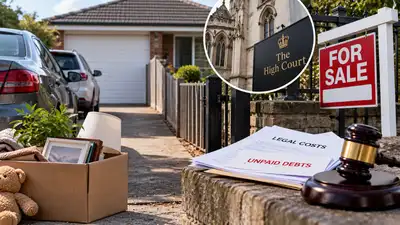
Image AI generated
How did a driveway dispute leave a woman £69,351 in debt
In a judgment handed down on 16 March 2026, the court upheld an earlier order allowing the property to be sold to recover unpaid damages and legal costs. The case, Kirsten Elaine McGowan v Marie Bernadette Potter [2026], concerned whether the County Court had the legal authority to order the sale. On 26 August 2020, an order required Potter to pay McGowan £30,452.95 in damages, together with £27,000 in legal costs. On 30 December 2020, the County Court Money Claims Centre made a final charging order against Potter’s property at 25 Bennetts Avenue, Shirley, in Croydon. McGowan applied to the County Court at Croydon in May 2021 for an order to proceed with the sale of Potter’s home. Following a hearing in December 2021, the court made an order dated 29 December, subsequently varied in January 2022. It provided that the sale would not proceed if Potter paid £77,373.56 by 28 January 2022. The order also required the property to be sold for no less than £575,000, although the minimum sale price was reduced later. The order further required Potter to provide vacant possession of the property by 25 February 2022. To facilitate the sale, it provided for a legal term of 3,000 years to be created and vested in McGowan under section 90 of the Law of Property Act 1925. A warrant for possession was enforced on 26 April 2023, resulting in her eviction. McGowan subsequently brought proceedings in the High Court on 23 December 2024, seeking an order under the Law of Property Act 1925 to create and vest the 3,000-year legal term needed to enforce the sale order. The dispute centred on the financial limits governing the County Court’s authority to enforce charging orders and make associated orders under the 1925 Act. Potter argued that the County Court’s powers under sections 90 and 91 were restricted to cases involving debts of no more than £30,000. McGowan’s case was that the relevant limit was the County Court’s wider equity jurisdiction, which had been increased to £350,000.
Because it had been made beyond the court’s legal powers, in October 2024, Potter challenged the County Court order. The ruling confirmed that the original order was valid, leaving Potter’s challenge unsuccessful on the preliminary issues considered by the High Court.
The proceedings arose from an earlier legal dispute between Kirsten Elaine McGowan and Marie Bernadette Potter over a shared driveway, according to the High Court judgment. The judgment described the case as “yet another cautionary tale about the financial consequences of neighbour disputes for those without deep pockets”. The High Court has ruled that the sale of a woman’s home can proceed after she was evicted following a long-running dispute with her neighbour over a shared driveway. Potter did not pay the sums awarded, and the amount owed continued to increase as interest accrued and further legal costs were incurred. Potter did not give possession as required. At the time of the High Court proceedings, the property had not been sold, and the outstanding debt remained unpaid. The proceedings focused on whether the County Court had jurisdiction to make the original order and, if it did not, whether that would render the order invalid. The High Court considered the relationship between these provisions before determining whether the original sale order had been lawfully made.