
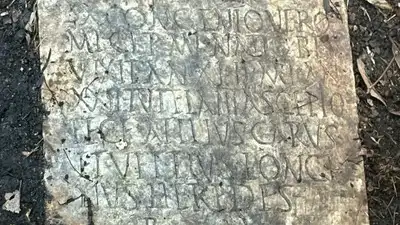
A long-lost ancient Roman artifact reappears in a New Orleans backyard, PC: D. Ryan Gray/Preservation Resource Center of New Orleans
In early 2025, Daniella Santoro, an anthropologist at Tulane University, and her partner, Aaron Lorenz, were clearing weeds behind their home in New Orleans’ historic Carrollton neighbourhood when they uncovered a marble slab covered in Latin writing. The stone commemorated Sextus Congenius Verus, a 42-year-old sailor who had served for 22 years aboard a ship called the Asclepius . Its discovery transformed an unremarkable garden stone into a nearly 2,000-year-old artefact with a traceable history. In 2004, she placed the stone in the garden of the New Orleans property.
Santoro contacted D. Ryan Gray, an archaeologist at the University of New Orleans, who shared photographs of the stone with Harald Stadler, an archaeologist at the University of Innsbruck, and Susann Lusnia, a classical archaeologist at Tulane. Lusnia recognised the inscription as an ancient Roman funerary monument. Further research established that the marble monument had once belonged to the collection of the National Archaeological Museum in Civitavecchia, Italy, where it had eventually been recorded as missing. The breakthrough came after news of the discovery became public. The artefact had belonged to her grandparents. Her grandfather, Charles Paddock, had served in Italy during World War II, and the stone eventually made its way into the family’s possession. O’Brien did not know that it was an ancient Roman funerary monument. She later explained that the family had planted a tree and decided to put the unusual stone outside in the garden as part of the new home’s landscaping. For years, the monument remained there without anyone realising what it was. It was only after Santoro and Lorenz uncovered it beneath the vegetation and archaeologists examined the inscription that its true age and history came to light. The family has not established exactly how Paddock acquired the monument in Italy. It remains possible that he purchased it, obtained it through another transaction or brought it home as a wartime souvenir, but there is no definitive family record explaining how it left Italy.
Erin Scott O’Brien, who had previously lived at the New Orleans property, learned about the Roman monument and immediately recognised the stone from her family’s history.
The stone spent years looking like an ordinary piece of marble in a New Orleans garden, while the inscription beneath the surface carried the name of a Roman sailor who lived almost 2,000 years ago. The monument is expected to return to the National Archaeological Museum in Civitavecchia, where it can once again be preserved and studied in the country from which it disappeared. For the researchers who identified it, the discovery demonstrates how easily an ancient artefact can become detached from its history. What began with a couple clearing vegetation behind their home ultimately connected archaeologists in Louisiana, Austria and Italy, a missing museum artefact, and a World War II family story. The stone’s journey from ancient Rome to Louisiana and, eventually, back toward Italy is now part of the history preserved alongside the monument itself.