
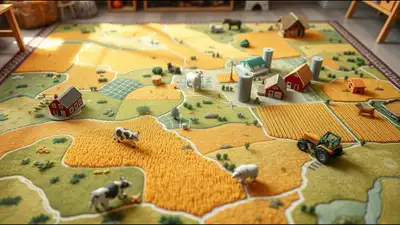
Representative Image of a colorful map-themed play rug featuring various agricultural fields and farm buildings (AI Generated Image)
Boundri was started in 2022 and grew from a play rug Faleide made for his children into a company that now puts personalised maps on rugs and other products. An autumn 2022 report from Agweek described Boundri’s initial offering as generic farm-print rugs, with custom products expected to follow. The FAQ says the files must currently be JPG or PNG and smaller than 50 MB. DTN used the phrase when it covered the business in 2022, while Boundri uses it on its product pages to describe the children who play with its farm rugs.
AgWeb also reported that the product gained attention on Twitter as the business began taking off.
The company says its rugs are made from polyester chenille, have hemmed edges and a no-skid polyester backing, and can be cleaned with dish soap, a rag and a hose. It also says the rugs fold for storage and are lightweight. It says satellite, plane or drone images can be uploaded through the company’s Custom Product Builder, rather than through its main-page products. The company says a proof is provided before the item is printed. The company says these custom projects are handled on a case-by-case basis. The phrase “carpet farming” appears in both coverage of Boundri and the company’s own current website.
A North Dakota farm kid has turned real agricultural maps into children’s play rugs, giving toy tractors and combines a miniature version of the landscapes they come from. Nathan Faleide, founder of Boundri, grew up on a farm in North Dakota and around agricultural mapping through his family’s Satshot business. The early launch eventually developed into the personalised products that now form a major part of Boundri’s range. Rather than limiting the designs to generic farm scenes, the company built its products around maps and imagery connected to specific locations. Farm play rugs remain one of Boundri’s main products. Its current site lists personalised farm play rugs in three sizes and also offers custom-upload rugs and other mapped products. For customers who already have their own imagery, Boundri’s FAQ provides more specific instructions. Boundri’s product page also explains the proof process. Customers can order an item and then send a note explaining any changes they want. The business now extends beyond children’s play rugs. Boundri’s website lists blankets, puzzles, onesies, canvas prints and other mapped products, while its wall-map and mural work can include features such as field boundaries, attributes and other map layers. Its current Custom Upload Rugs page, for example, describes the product as a gift for “little carpet farmers. The concept gives children something more specific than a generic farm-themed play surface. Boundri’s products can represent actual locations, turning maps associated with farms and other meaningful places into physical objects that can be used, displayed or given as gifts. For Faleide, the business brings together two parts of his background: farming and agricultural mapping. The technology behind Satshot grew from his family’s experience with agricultural imagery and mapping, while Boundri has taken that knowledge into a very different kind of product. What began with a farm-toy rug for his own children has grown into a business built around putting maps onto objects people can use and keep. You use AI every day. Now get your AI Quotient. Take the AIQ test.
Today, Boundri sells mapped play rugs, blankets, wall maps, prints and other customised products, while its mapping background stretches back decades through the Faleide family’s work in agricultural technology.
Satshot’s history dates to 1994, when Lanny Faleide, Nathan’s father, built software to create variable-rate maps using satellite imagery. Satshot says Lanny had more than 20 years of farming experience at the time and that the idea grew from flying as a pilot over his own fields and those of neighbouring farmers in the mid-to-late 1980s. DTN reported in December 2022 that Faleide had nearly 25 years of experience in precision agriculture and mapping at the time and had long wanted to do more imagery-based art. DTN reported that about 230 orders came in while the business was still in its early stages.
The publication reported that when he introduced an early prototype, his children began playing with their farm toys on it.
On Boundri’s current About Us page, he says he grew up on a farm in North Dakota and that farm toys were central to his daily routine. He also says he “did farm a little” himself, but adds that it “wasn’t my time. Faleide says that experience helped develop his expertise in software and maps, eventually providing the technical background behind Boundri. Satshot’s current website describes Satshot as a brand, service and product of Boundri Inc., and says the technology created by Lanny has continued in a new direction with Nathan Faleide. It also says Boundri will continue to run the Satshot brand, product and service “for the time being” while developing new connections and tools around mapping and imagery. On Boundri’s own website, Faleide says the business began with a farm-toy play rug he made for his children. He describes the family as the inspiration for Boundri and says the project grew after seeing the enjoyment his children got from the rug.
Faleide’s connection to farming began early. At the same time, he grew up around agricultural mapping through his family’s company, Satshot. The company also links the development of the technology to difficult conditions in farming during that period. The technology has since continued under Boundri. The first idea was much closer to home. A photograph of the rug was subsequently shared by a friend on Twitter, after which orders began arriving.