
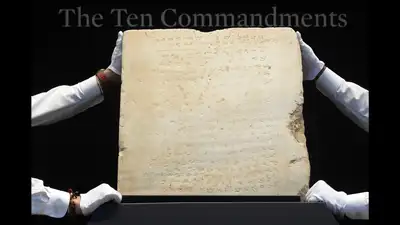
PC: AP News
A rare stone tablet inscribed with the Ten Commandments sold for $5.04 million at a Sotheby’s auction in New York on 18 December 2024, decades after it was reportedly used as a paving stone. The tablet was discovered during railway construction near the coast of what is now southern Israel in 1913, but its historical significance was not recognised immediately, according to The New York Times. Sotheby’s dated the 115-pound artefact to the late Roman-Byzantine period, around 1,500 years ago. The tablet’s discovery dates back to 1913, when a railway was being built near the coast of what is now southern Israel. Kaplan published his findings in 1947 in The Bulletin of the Jewish Palestine Exploration Society, a scholarly journal. He died in 1989. The absence of archaeological excavation records from 1913 became a central issue in discussions about the stone’s authenticity. Its sale followed more than 10 minutes of bidding and exceeded the auction house’s original estimate of $1 million to $2 million.
Because its discovery lacked independently verifiable archaeological documentation, however, experts questioned its provenance and authenticity. The stone’s journey from its reported use as a paving stone to a multimillion-dollar auction therefore remains closely linked to both its historical claims and the continuing debate over its authenticity. Jacob Kaplan, who later investigated the stone, reported that it had been found during the construction work. The account of the discovery subsequently became part of the tablet’s documented history, although experts later questioned whether the reported circumstances could be independently verified.
The anonymous buyer who purchased the tablet at Sotheby’s planned to donate it to an Israeli institution, according to the auction house. Sotheby’s said the artefact would have a home where it could be preserved and continue to be studied. Rather than being immediately recognised as an important historical artefact, the inscribed stone was reportedly used as a paving stone at a nearby home, with its inscription facing upwards as it was set into the ground. The auction established the price paid for the tablet, but the questions surrounding its origins remained a separate matter. physical condition and scholarly research, experts highlighted the lack of independently documented archaeological evidence While Sotheby’s presented it as an exceptionally significant religious artefact and cited its inscription. You use AI every day. Now get your AI Quotient. Take the AIQ test.
It reached an Israeli antiquities dealer in 1995 before being acquired by the Living Torah Museum in Brooklyn. In 2016, collector Mitchell S. Cappell purchased it for $850,000. Cappell later consigned the stone to Sotheby’s, where it was auctioned in December 2024. Sotheby’s described the tablet as approximately 1,500 years old and associated it with the late Roman-Byzantine period. The stone weighs 115 pounds, measures two feet in length and bears an inscription in Paleo-Hebrew, an early form of Hebrew writing. Rollston also challenged the account that the tablet had been used as a paving stone after its discovery in 1913. He said, “Forgers during the past 150 years, when they fabricate their forgeries, often throw in surprising content.
He said that it was possible the tablet had been carved closer to the time of its reported discovery, rather than centuries earlier. Rollston specifically questioned the inclusion of the Mount Gerizim directive, suggesting that unusual details can sometimes be introduced into forged inscriptions to attract interest.
Patty Gerstenblith, director of the Centre for Art, Museum and Cultural Heritage Law at DePaul University College of Law, described the auction result as “remarkable” but emphasised that doubts about the artefact needed serious consideration. In an email quoted by The New York Times, Gerstenblith said, “The inscription has no objectively verifiable origin, such as discovery during a documented archaeological excavation. He said, “Objects from this region of the world are rife with fakes. “But there is no way that this can be known,” Rollston said in an email quoted by The New York Times. “The problem is that we have zero documentation from 1913, and since pillagers and forgers often concoct such stories to give an inscription an aura of authenticity, this story could actually just be a tall tale told by a forger or some antiquities dealer,” he said. Sharon Liberman Mintz, the auction house’s international senior specialist in Judaica, books and manuscripts, said the tablet had been “widely studied, researched, and published by the world’s leading scholars.
The tablet eventually entered the antiquities market. The auction house cited the lettering, wear and weathering as evidence relevant to determining its age. Selby Kiffer, Sotheby’s international senior specialist for books and manuscripts, highlighted the importance of the script, stating, “The script is a key to it. We know when it went out of common usage. Despite Sotheby’s claims about the tablet’s age and significance, specialists raised concerns about its provenance, meaning the documented history of an object’s ownership and discovery. She also questioned aspects of the discovery account, noting that “Several elements of the story, such as that its significance was unrecognised for several decades, seem to stretch belief. Her concerns centred on the lack of independently verifiable archaeological evidence establishing when and where the tablet was originally found. Brian I. Daniels, director of research and programmes at the Penn Cultural Heritage Centre in Philadelphia, also highlighted the risks associated with antiquities from the region. However, he acknowledged that the tablet could still prove genuine, adding, “Maybe it’s absolutely authentic, and this truly is a historic find. Christopher A. Rollston, chairman of the Department of Classical and Near Eastern Languages and Civilisations at George Washington University, questioned whether the stone could reliably be dated to the late Roman-Byzantine period. He added, “After all, these were not found on an archaeological excavation. We don’t even know who actually found them. He pointed to the absence of contemporary records and the possibility that stories about an object’s discovery could be fabricated to make it appear more authentic. It omits the prohibition against taking the Lord’s name in vain and includes an instruction to worship on Mount Gerizim, a sacred site for the Samaritans in what is now the West Bank. He added, “And they do this to garner more interest in their forgery. These concerns formed part of the wider debate over whether the tablet’s inscription reflected an ancient religious tradition or a later fabrication. Sotheby’s, meanwhile, defended the research conducted on the artefact. She described its significance as undisputed and welcomed the prospect of it being preserved in an Israeli institution. The Israel Antiquities Authority was also pleased that the artefact would return to Israel.
The tablet contains a version of the Ten Commandments that differs in certain respects from the wording commonly known today.