
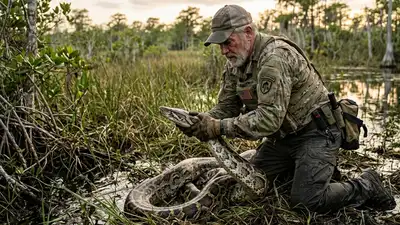
A retired US Army veteran has spent 11 years tracking invasive Burmese pythons through Florida’s Everglades, where a single capture can bring extra pay but hours of searching may yield nothing. WUSF Public Media reported that the state pays contractors up to $18 an hour for searching on foot, with additional money for each snake caught. Yet the work is far from an easy way to earn a living. Hunters must navigate dense wetlands, handle powerful reptiles at close quarters and follow strict rules for their removal. Their efforts target a growing threat to Florida’s native wildlife.
Under the rates reported by the Associated Press in August 2024, contractors received $13 an hour while driving along back roads and $18 an hour when searching on foot in the wetlands. They could also earn $50 for a python measuring up to four feet, followed by another $25 for each additional foot. By the end of 2023, more than 18,000 Burmese pythons had been removed from the wild through Florida’s efforts, according to figures reported by the Associated Press. Contractors accounted for about 11,000 of those removals. In 2024, more than 600 hunters entered the 10-day event, which concluded on 18 August. Participants competed to remove as many pythons as possible, with a $10,000 grand prize for the person who humanely killed the highest number under the competition’s rules.
The payment structure combines hourly rates with a fee for each animal caught. The arrangement rewards successful catches but does not guarantee a steady income. Hours spent searching do not necessarily produce a snake, and the work can involve repeated trips through the same areas. Aycock has been clear about the financial limitations, describing the earnings as supplementary rather than enough to support someone working at it full-time. The state’s annual Florida Python Challenge offers another route for members of the public to take part in the removal effort. The event is designed to encourage people to search for invasive snakes over a limited period, while drawing attention to the ecological damage they can cause. Aycock takes part in the competition each year.
Aycock has spent 11 years hunting Burmese pythons in the Everglades. Females can lay dozens of eggs in a single clutch, with an average clutch containing roughly 29 to 50 eggs. A 2012 study cited by the USGS recorded steep declines in several mammal populations across parts of the Everglades following the establishment of Burmese pythons. Raccoon numbers had fallen by 99.3 per cent, opossums by 98.9% and bobcats by 87.5% compared with earlier levels. The state has employed contractors to search for the snakes throughout the year since 2017, through a programme involving the Florida Fish and Wildlife Conservation Commission and the South Florida Water Management District. Aycock recalled capturing one measuring 17 feet, or around five metres. The snakes have to be handed over to the wildlife agency within 24 hours, and transporting a live invasive snake is restricted to licensed contractors. During the Associated Press team’s visit in August 2024, he continued looking well past midnight without finding a python.
Because the snakes prey on a wide range of mammals and other animals, established populations in the southern part of the state have become a serious concern for wildlife managers. The process is part of the requirement that captured pythons be humanely killed rather than released elsewhere.
Rahill has spent years in the wetlands and says familiarity with the terrain helps him judge when conditions might favour a successful search. His work takes him along isolated roads and into wetland areas where the snakes have been spotted before. He divides his time between North Carolina, Florida’s Panhandle and Homestead, where he keeps a recreational vehicle while working in South Florida. The conditions can help determine whether a search succeeds. Falling temperatures and moisture collecting on a vehicle’s windscreen can signal a change in the night air, which Aycock associates with increased python activity. Rather than rushing through an area, he scans the vegetation and checks places where young snakes might emerge. Burmese pythons can remain difficult to see against the surrounding vegetation, and a hunter may spend hours looking without finding one. Aycock has described going for months without a catch, despite returning repeatedly to familiar areas. Florida does not permit hunters to use firearms to kill the snakes, so capturing them requires close contact. their size, strength and ability to strike make restraint difficult, particularly when a large animal is involved Although Burmese pythons are not venomous. Burmese pythons are not native to Florida. Their spread through the Everglades has been difficult to measure precisely, leaving scientists without a reliable count of the entire population. The US Geological Survey has estimated that tens of thousands of pythons may be present in South Florida. That reproductive capacity makes it difficult to control the population through occasional hunts alone. The consequences for native animals have been documented in research. Florida’s python removal programme offers contractors a way to earn money while helping wildlife authorities tackle the problem. There is no single method that works in every encounter. Some hunters use a snake hook to control an animal before restraining it, while others rely on their hands when the python appears calm enough to handle. Experienced hunters also learn to recognise signs that a snake may be nearby, from its position in the vegetation to the smell they associate with its presence. Tom Rahill, founder of the Swamp Apes, a veterans’ therapy organisation involved in invasive snake removal and environmental work, is among those who hunt alongside Aycock. Even experienced hunters can face a difficult struggle when they encounter a large python. He and his wife had to manoeuvre around the animal before he could secure its head and prevent it from lunging at them. A second person can be essential when restraining a large snake. The animal must be kept under control until it can be secured, and hunters need to ensure it cannot escape during transport. Their work involves more than spotting a snake and lifting it from the grass. Once a python has been captured, the contractor must follow Florida’s rules for handling and delivery. Aycock takes the animals home before euthanising them with a captive bolt, a method used to kill the snake. For someone who likes snakes, this is the hardest part of the job. Aycock has spoken about his reluctance to kill the animals, even while recognising the environmental reasons for removing them. His work is directed at the damage caused by an invasive population, rather than a general dislike of the species. The group eventually stopped for the night, only for Rahill to spot a hatchling about an hour later. Such outcomes are familiar to people who work in the Everglades. A night of searching may yield nothing, even when hunters know the habitat and have spent years learning where the snakes are likely to hide. On other occasions, a brief glimpse in the grass can lead to a catch. You use AI every day. Now get your AI Quotient. Take the AIQ test.