
Image: Storyful
A San Francisco woman has given a glimpse of what home cleaning could look like in the age of humanoid robots after hiring one for $30 an hour to work inside her apartment. In that sense, today’s $30 cleaning visit is both a household service and a real-world test of how humanoid robots behave in unpredictable domestic environments. Because it is operated remotely, the robot also depends on a working internet connection and electricity. Because a humanoid machine is now being sent into real homes to perform paid household work, the service is therefore still an early-stage experiment rather than a conventional autonomous cleaning business, but it represents a notable step.
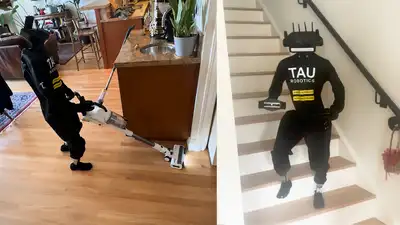
Capezio said the robot was slower than a human cleaner but still did a solid job and she did not have to redo its work afterwards. Tau says its robots are jointly operated by humans and AI, with the balance between direct human control and higher-level guidance varying depending on the task. The company says its robots can vacuum floors, wipe surfaces, take out rubbish and move ordinary objects such as chairs and laundry baskets to clean around them.
Gianna Capezio booked a one-hour cleaning visit from San Francisco startup Tau Robotics, with the humanoid robot vacuuming, making her bed and cleaning her bathroom during the session. The robot was not operating autonomously. A trained human operator controlled it remotely through its cameras, with artificial intelligence assisting the system. Her video of the unusual cleaning session quickly spread online, attracting millions of views and sparking debate over the technology, its usefulness and the future of household work. Customers cannot simply leave the robot alone inside an empty property. Tau’s terms require the customer or another authorised adult to remain at home throughout the visit, and the company does not accept keys, lockboxes or door codes. The most important part of Tau’s system is that the humanoid is not yet capable of independently cleaning an entire home. Tau’s own terms state that the robot is operated in real time by a trained human operator working from the company’s facility, while AI assists with the robot’s operation. The company’s long-term objective is to reduce that dependence and eventually have its robots perform more of the work autonomously. That makes the current service different from a fully independent household robot. A person is effectively guiding the machine while the customer watches it carry out physical tasks inside the home. The approach also allows Tau to gather information from real cleaning sessions that can be used to improve its AI models. Tau’s humanoids are designed to perform relatively straightforward household tasks rather than every job a human cleaner might undertake. Tau also advertises specialised cleaning options, including kitchen and bathroom work and deeper cleaning involving areas such as baseboards, grout and window tracks. There are clear restrictions, however. The robot does not climb ladders, work outside the home, handle biohazards or pest infestations, move heavy furniture or appliances, or handle firearms, medication, drug paraphernalia or cash. Bedrooms and bathrooms are excluded from a standard booking unless the customer specifically opts them in. Capezio’s experience showed that the technology can already complete several recognisable household chores, although she noted that the robot moved more slowly than a human cleaner. That limitation is also visible in footage of Tau’s robots, whose deliberate movements highlight how far current humanoid robotics still has to go before machines can match the speed and adaptability of experienced human cleaners.