
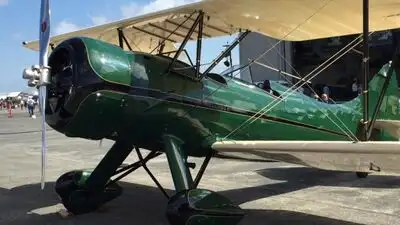
The restoration preserved some of the aircraft’s original components in unexpected ways. (Photo: Vintage Aviation News)
A World War II-era training aircraft that spent nearly five decades packed away in boxes after its retirement, moving with its private owner from one place to another, has now been restored to airworthy condition.
The WACO UPF-7, serial number 5650, began its training role in 1941, Vintage Aviation News reported. In 1953, the WACO was retired and bought by a private owner in Florida. The aircraft remained in storage as its owner moved three times over a period of 50 years, carrying the boxed-up parts with him. In 2002, a pilot rediscovered the aircraft in the owner’s storage unit while acquiring a Piper aircraft from him on behalf of RARE Aircraft Ltd. of Faribault, Minnesota. The WACO UPF-7 was built between 1937 and 1942 as a primary trainer. It is estimated that 50% of World War II pilots received their initial training in a WACO UPF-7. The company that became known as the Weaver Aircraft Company was started by George E Weaver, Clayton Bruckner and Elwood ‘Sam’ Junkin in Troy, Ohio, in 1920. By 1929, the company was known as Waco Aircraft Company, according to the report. By the time the company left aircraft production in 1947, it had produced 62 different aircraft models that were operated in 35 countries. The UPF-7 was among the aircraft used in the CPTP. These arrangements also included yearly hangar leases for $1. After the UPF-7 was retired in 1953, its private owner in Florida chose to preserve it rather than dispose of it.
It was purchased by Unger Aircraft Association through the Civilian Pilot Training Program (CPTP), a government-backed programme created to help train pilots before and during World War II. The aircraft later also helped train pilots connected with the Korean War era. Instead of being scrapped, the aircraft was taken apart and packed into boxes. The owner planned to restore it himself one day, but that restoration did not happen for decades. This changed the story of the aircraft. It had a combination of wood, steel and fabric construction, along with an open cockpit. Depending on the aircraft, the type could be fitted with a Jacobs or Continental engine and a Hamilton propeller. Its design made it suitable for people learning the basics of flying. The aircraft was considered easy to manoeuvre and stable, qualities that were important for primary pilot training. The aircraft’s history was linked to the wider development of WACO. During the 1930s, it built and sold more aircraft than all other US commercial aircraft companies combined. At the time, the US government wanted to support pilot training for college students while the country was still following an isolationist policy at the beginning of World War II. Civilian Fixed Base Operators, or FBOs, such as Unger, purchased aircraft for the programme. They could then recover their investment through federally funded training programmes such as CPTP. The aircraft was dismantled and placed into boxes with the intention of carrying out a restoration at some point.
The owner carried the boxes through three moves over the next five decades before the aircraft was rediscovered in 2002. Photographs by aviation historian and writer Randy Malmstrom show the restored aircraft, including its two open cockpits, instrument panel, landing gear and Jacobs R-755 engine. After the dissolution of the foundation, the WACO UPF-7 was sold to a private owner in Lakeland, Florida.
RARE Aircraft therefore obtained N32018 from the US Federal Aviation Administration for the restored WACO. That decision meant the aircraft survived, but it also left it forgotten for many years. RARE Aircraft then took on the restoration. Much of the aircraft’s steel framework was retained, while a large portion of the wood was replaced. The original aircraft had a Grade A cotton covering. During the restoration, much of this was replaced with Dacron, which is now a standard material used in aircraft restoration. The restoration also preserved some of the aircraft’s original components in unexpected ways. The original wing ribbing was later used as a conference room table at the museum where the aircraft was displayed. The aircraft’s registration also required a change. Its original registration number, N32019, had been used on another aircraft. After restoration, the aircraft was fitted with a Jacobs R75582M engine and a Hamilton Standard constant-speed propeller. It became airworthy and was displayed at the Historic Flight Foundation. The aircraft was displayed at the Historic Flight Foundation when the museum was located at Paine Field in Everett/Mukilteo, Washington. The foundation later moved to Spokane. The aircraft’s time with the Historic Flight Foundation eventually came to an end. Catch the latest World News and Live updates. Download the TOI app.