
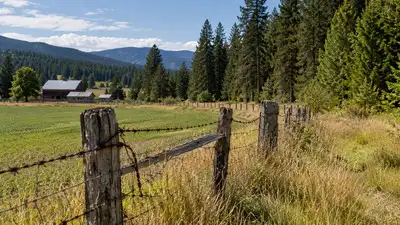
Greg and Leah Sempel claim they used the disputed land for decades before Idaho acquired it in 1996. (AI image)
An Idaho couple who have farmed in Benewah County since 1979 have won another chance to claim 5.95 acres of disputed land after the state Supreme Court overturned an earlier ruling in Idaho’s favour on Tuesday. However, the state claims the land belongs to it and sued the couple in 2022 over its alleged unauthorised use. The state, however, has documents showing that the disputed 5.95 acres are part of a much larger property it acquired in 1996. The story began in 1979, when Greg’s parents purchased the property for him and Leah to use. It belonged to Milwaukee Land Company until 1981, when Potlatch Corporation acquired it. In December 1996, Potlatch transferred more than 4,100 acres to the State of Idaho through a land exchange. The disputed 5.95 acres were included in that transfer. Years later, a survey carried out in 2016 raised questions about the couple’s use of the land. In August 2022, Idaho took the couple to court. The Sempels said they had been using the disputed area openly since 1979 and had treated it as part of their farm. The couple argued that they had met those conditions by 1984, long before the state acquired the property.
Because an old barbed-wire fence had marked their property’s boundary for decades, greg and Leah Sempel believed the land was theirs. Because that was what they had been told when the property was purchased, they say the land inside the fence was theirs.
The couple run Pokey Creek Farm, where they have grown crops, kept animals and built structures over the years, according to the judgment . They said the fence had been there long before they arrived, and they continued to treat it as the boundary. Before the purchase, Greg said he walked around the land with Tom Rathbone, a representative of the company selling it. During that visit, Rathbone pointed towards a barbed-wire fence and told him it marked the northern boundary. Henning told him that the fence had been built in the 1960s after an agreement with the company that owned the neighbouring land, according to Greg. It had been accepted as the boundary by previous landowners, according to their account. On the issue of property taxes, Greg said he and Leah had always paid taxes on their property, but the lower court found that they had not provided enough evidence to establish it.
With the Supreme Court’s latest ruling, the competing claim will be examined again. The couple say they had followed that boundary ever since. In their early years, they planted crops and kept horses in the area. During the 1980s, they harvested timber, laid a gravel access road and built several structures. In the following decade, they added a greenhouse and raised livestock. They also claimed that government workers carrying out logging operations had treated the fence as the dividing line between the properties. the neighbouring property changed hands While the Sempels continued farming. The state claimed that they were occupying part of its property without permission. Apart from asking the court to recognise its ownership, it sought compensation over the alleged unauthorised use of the land, timber removal and property damage. They relied on a legal principle known as adverse possession, which can allow someone to claim ownership of land they have occupied for a required period, provided certain conditions are satisfied. They also maintained that the fence was not simply something built to keep animals inside. The lower court, however, ruled in the state’s favour on the ownership dispute. The couple challenged that decision in the Supreme Court. For now, neither side has secured a final victory in the ownership dispute. The Supreme Court has sent the case back for further proceedings, where the couple’s claims will have to be considered again. You use AI every day. Now get your AI Quotient. Take the AIQ test.
But the Sempels argue that they had already been using the area for many years before the state became its owner. Greg later spoke to Chester Henning, who had owned the property previously.
the judges said that statement could not simply be treated as though no evidence had been presented Although older receipts were unavailable. However, the judges said its present condition did not establish what it looked like when the couple first occupied the property or whether earlier landowners had accepted it as the boundary. The Supreme Court found that the lower court had dismissed important parts of the couple’s case without properly considering the evidence. For example, Greg had given a sworn statement saying they had paid their property taxes. The court also considered whether taxes paid on the couple’s recorded property could count towards the disputed area under an exception recognised by Idaho law. Photographs showed that some sections of the wire fence had become embedded in trees as they grew. The state argued that the fence was irregularly shaped and had fallen into disrepair.