
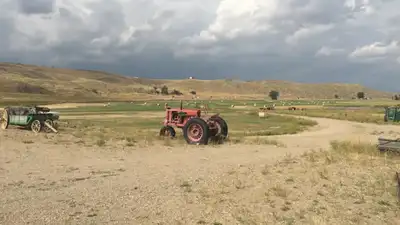
Colorado farmer Marc Arnusch had a straightforward choice: accept millions of dollars from solar companies seeking to lease 2,700 acres of his family’s farmland, or keep the property in agriculture for the next generation. Now, after spending nearly $1 million documenting a conservation easement, he is facing an IRS audit over the tax deduction associated with it.
Arnusch, a third-generation farmer in Weld County, said the solar offers were tempting but ultimately incompatible with what he wanted for the land. He chose the farm. Reporting by Just the News, recent statements from the Internal Revenue Service and reporting by Colorado Public Radio help illuminate the dispute and the broader debate over conservation easements.
19, the agency announced the creation of an Office of Conservation Easements, saying the new office will centralize technical expertise and coordinate policy, enforcement and case-resolution strategies involving conservation and historic-preservation easements.
An IRS employee visited the farm, and he questioned whether the person conducting the review had the expertise necessary to evaluate such a complicated property, according to Arnusch. Arnusch said the family had relied on numerous experts throughout the process, but the IRS later sent an auditor who, according to Arnusch, was conducting their first audit of a farm. Then, roughly three years after the deduction was claimed, the IRS opened an audit. The IRS did not respond to requests for comment. On Aug. The IRS simultaneously ended its current uniform settlement initiative, saying standardized settlement letters were not suited to the variety of cases it was handling.
Bernie Donachie, a value-analytics specialist with interests in conservation-easement properties, examined 10 publicly available cases. He found that taxpayers’ experts had collectively valued the properties at $358.2 million, while IRS valuations totaled about $1.57 million, a reduction of roughly 99 percent, according to his analysis reported by Just the News. Because he wanted his family’s land to remain a farm rather than become a solar development, he chose conservation.
Arnusch’s experience is part of a much larger fight over conservation-easement valuations. Critics of the IRS’s approach argue that government reviews can reach dramatically lower valuations than those produced by taxpayers who commission extensive expert studies. Those figures represent Donachie’s sample, not an official governmentwide assessment. For Arnusch, however, the issue is more personal than a dispute over a tax bill. Now he is waiting to see whether the government will accept the valuation that helped him make that choice. He does not want to keep fighting the government; he simply wants to protect the farm. For a family that has spent generations working the same ground, the question is whether preserving that future will ultimately come with a tax price they cannot afford.