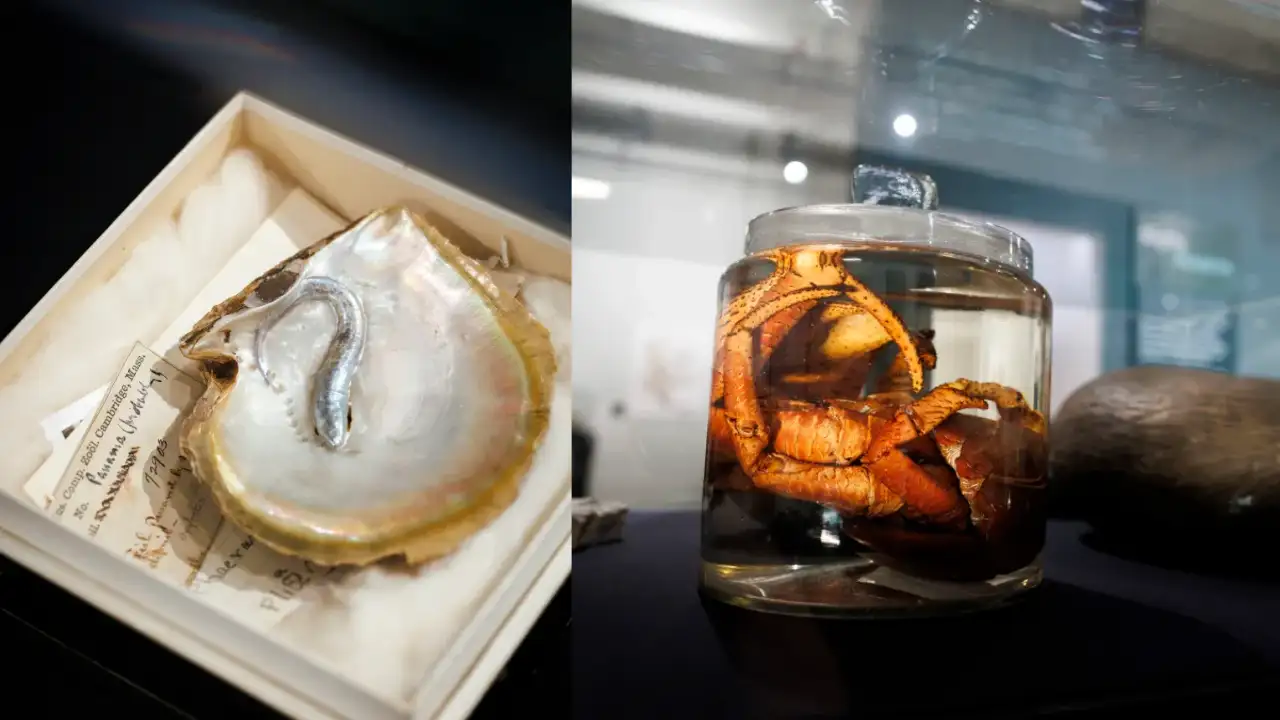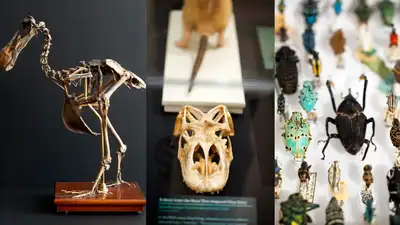
Image: From Left to Right/Dodo skeleton/Tony Rinaldo/Jewel-like beetles and weevils and Komodo dragon skull/Stephanie Mitchell
What the exhibition at the Harvard Museum of Natural History shows and when you can visit
At the Harvard Museum of Natural History in Cambridge, Massachusetts, the objects on display are a tiny percentage of the total collection, with experts caring behind the scenes for 26 million specimens. The exhibition, ‘Collecting Wonders: Tomorrow’s Discoveries’ opened on 27 June 2026 and runs through April 2027 in the museum’s main gallery space. The show draws on a collection of more than 26 million individual objects, and the Harvard Gazette reports that it is open daily from nine in the morning to five in the afternoon. The dodo, whose last widely accepted sighting was in 1662, appears as a whole articulated skeleton; it was last displayed nearly twenty years ago, alongside a feathered model. Visitors can also see the golden toad, discovered in 1964 in Costa Rica’s Monteverde Cloud Forest Preserve and declared extinct in 2004. A 300-million-year-old fern tells another story, ferns and other prehistoric plants were buried and pressed over millions of years into the coal that fuelled the Industrial Revolution. Beauty and research often overlap, as in this case, a rare form of crystalline gold looks like metallic coral, and a fossil slab from Morocco’s Atlas Mountains preserves swirling patterns left by cephalopods that swam in a shallow sea around 370 million years ago. Notably, a fully articulated polar bear, in the collection since at least 1878, is still used as a research tool.
Michaela Schmull, curator of ferns, says, “Discovering the stories is one of the best jobs.” Most visitors to a natural history museum see only a sliver of what it holds. From a dodo skeleton to jewel-like beetles, the objects span billions of years and show how scientists still use these old collections to study life on Earth. It is a collaboration between the Harvard Museums of Science and Culture and the university’s three natural history research museums, the Museum of Comparative Zoology, the Harvard University Herbaria and the Mineralogical and Geological Museum. Several specimens no longer exist in the wild. Ornithology collection manager Jeremiah Trimble explains that such specimens preserve a snapshot of a species and its location, letting researchers trace how its genetics changed over time. Beetles and weevils owe their metallic shine to crystalline scales, which society women of the mid-1800s used like sequins. Genetic material from its skin informs scientists about population diversity, while stable isotopes in its fur reveal ecological conditions during its life.
A new exhibition called ‘Collecting Wonders: Tomorrow’s Discoveries,’ brings some of the rarest, oldest and most beautiful of them into public view, many for the first time.