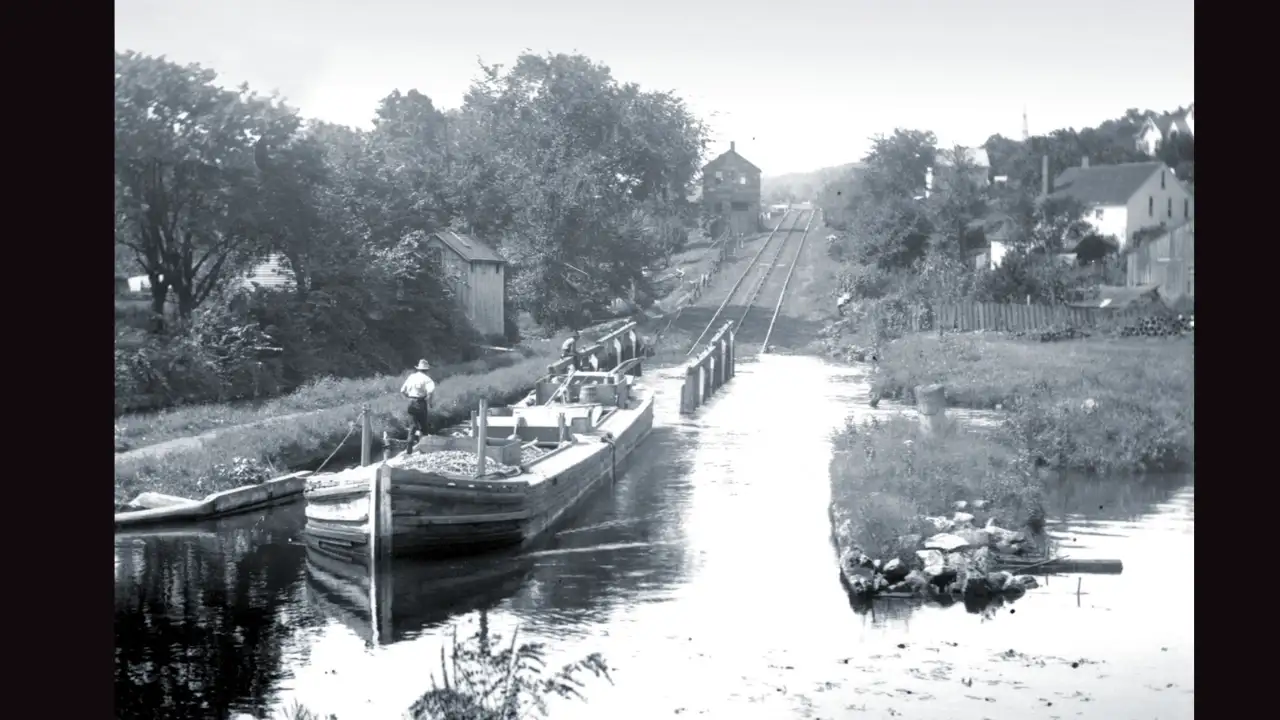
PC: Canal Society of New Jersey
In 1824, the Morris Canal & Banking Company was chartered to build a canal carrying Pennsylvania coal to markets along the eastern seaboard. The Canal Society of New Jersey says the waterway opened in 1831 and relied on 23 lift locks and 23 water-powered inclined planes. The inclined planes were essentially short railways that let boats change as much as 100 feet in elevation in 15 minutes, according to the American Society of Civil Engineers. The canal climbed 914 feet from Newark Bay to Lake Hopatcong, then dropped 760 feet to the Delaware River at Phillipsburg. The canal stretched 102 miles from Phillipsburg on the Delaware River to Jersey City, overcoming the rugged terrain of the state’s highlands, according to the Canal Society of New Jersey. It states that engineers had to manage an elevation change of 1,674 feet. The total length was 106 miles. This gave the canal an average vertical slope of 18 feet per mile.
This was steep compared with the Erie Canal’s relatively gentle slope of one foot per mile.
The hydraulic-powered inclined plane system was “the key civil engineering feature” that permitted the canal’s successful completion in 1831.