
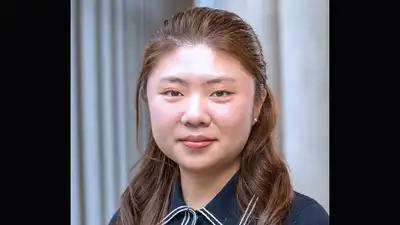
Claire Jian, Bergen County Academies, Hackensack, NJ (Source: Society for Science)
An 18-year-old student who was diagnosed with juvenile idiopathic arthritis in primary school has won seventh place and a $70,000 award in the 2026 Regeneron Science Talent Search for developing a new laboratory cell model of the disease. Jiang finished seventh among nearly 2,000 high school applicants from across the United States for her research into juvenile idiopathic arthritis (JIA), the most common form of arthritis in children, according to the award announcement from Society for Science and Regeneron. She then treated the cells with bone morphogenetic protein 4 (BMP4), a signalling protein strongly linked to joint damage in children with JIA.
Because researchers lacked laboratory models that accurately represented joint tissue affected by the disease, after being diagnosed with JIA, she learned that treatment options for young patients were limited, partly.
“Growing up with JIA was a little bit scary,” Jiang said in an interview with Science News Explores. Claire Jiang, a senior at Bergen County Academies in Hackensack, New Jersey, received the award during the annual competition run by Society for Science in Washington, DC. Jiang’s personal experience with the condition inspired her research. She first developed symptoms at nine years old and wanted to tackle a major problem in paediatric rheumatology: the lack of easy-to-use, disease-specific cell models for laboratory research. Jiang remembered the sudden start of her illness during a classroom exam in third grade. She developed a fever, swollen joints and difficulty moving her elbow. “I didn’t know anyone else who had it. Her friends and family didn’t know any more about JIA than she did. But now, she is on a mission to demystify the disease. To build a useful laboratory model, Jiang focused on fibroblast-like synoviocytes (FLS). These specialised cells line the joints and play an important role in inflammation and joint damage in people with arthritis. Working in her school laboratory during lunch breaks and weekends, Jiang used SW982, a human cell line commonly used to study adult rheumatoid arthritis.
The Regeneron Science Talent Search was established in 1942 and is the oldest and one of the most prestigious high school science and mathematics competitions in the United States.
“Adding to the scientific knowledge about an illness that affects her personally is honestly one of the greatest accomplishments I could ever have imagined,” Jiang told Science News Explores. “Research has really contributed to my self-confidence and being okay with talking about my diagnosis.” Finalists are judged by panels of leading scientists on the quality of their research, independent problem-solving skills and potential for future scientific leadership. Alongside her research, Jiang is an accomplished pianist who studies at the Manhattan School of Music precollege programme. She is also the head delegate of her school’s Model United Nations team and volunteers as an intern in a paediatric intensive care unit. Jiang hopes her work will encourage more open conversations about childhood chronic illnesses while helping researchers develop more targeted treatments.