
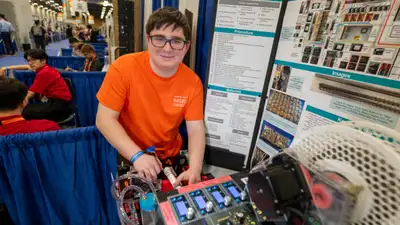
Davis, a student at Bishop Feehan High School in Attleboro, Massachusetts, built the machine as part of his science research project. The system uses waste plastic, including waste generated during 3D printing and converts it into filament that can again be fed into a 3D printer.
For 16-year-old Benjamin Davis, those leftovers were something else altogether. His invention addressed a growing waste problem and won him $75,000 at one of the world’s largest science competitions, states an online report by the Society for Science. The Society for Science reported that Davis developed a system that was roughly 45 percent more efficient than using the existing approaches separately.
A failed 3D print typically goes straight to the trash with a tangle of plastic filament, a misshapen object or a handful of scraps that no longer feel useful. For Davis, they were raw material, waiting for another chance. The Massachusetts high school student spent hundreds of hours developing a small recycling system to convert discarded 3D-printing plastic into usable filament. Davis, a student at Bishop Feehan High School in Attleboro, Massachusetts, built the machine as part of his science research project. The system uses waste plastic, including waste generated during 3D printing and converts it into filament that can again be fed into a 3D printer. The process could let users recycle material from failed prints and other plastic waste instead of buying new filament over and over again. The invention uses two methods of processing plastic: pultrusion and extrusion.
The next step for Davis
The award was another prod for Davis to continue exploring in the field. His work in plastic recycling and extrusion has made him more interested in advanced manufacturing and mechanical and materials engineering. Those interests could affect his studies when he goes off to college. For now, his invention presents a simple but potentially powerful idea: the plastic waste from a 3D printer doesn’t have to be the end of the story.