
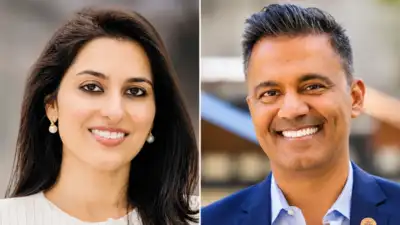
Pia Dandiya and Dr Amish Shah
Tuesday, November 3, was a remarkable day for Indian Americans. Dandiya, a former educator and technology executive, won Florida’s 22nd Congressional District. Shah, a physician and former Arizona state legislator who has spoken proudly of his Jain heritage, won Arizona’s 1st Congressional District.
The community gained two new members of Congress, celebrated victories in state and local elections, and witnessed a historic breakthrough in Los Angeles, the city I have called home for the past four decades. Indian American Nithya Raman defeated incumbent Karen Bass to become mayor of America’s second-largest city. Together with New York City Mayor Zohran Mamdani, she represents the growing presence of Indian Americans in the leadership of major American cities. These victories came amid increasingly hostile rhetoric from elements of the far right, including attacks on Indian immigrants, professionals and religious traditions. Against that backdrop, the results offered a powerful reminder of America’s democratic promise. For me, as a Jain American, the congressional victories of Pia Dandiya in Florida and Dr. Amish Shah in Arizona carry particular significance. Both are Democrats who entered politics after establishing successful professional careers, reflecting a growing commitment to public service among Indian Americans.
Estimates place the Jain American population at approximately 160,000, a tiny fraction of the American population. To put that in perspective, Los Angeles County alone has approximately 9.7 million residents. Our entire community amounts to roughly 1.6 percent of that county’s population.
Jainism is among the world’s oldest living religious traditions, with roots extending back thousands of years in India. Yet its followers remain relatively few, with the overwhelming majority living in India. For generations, Jain Americans have been better known for their achievements in business, medicine, education and philanthropy than for their participation in electoral politics. We have built temples, community centers and educational institutions across the United States. We have supported universities, hospitals and charitable causes. But political representation in this country has remained largely beyond our reach. For a community as small as ours, seeing a Jain American elected to Congress is the political equivalent of landing a person on the moon. It represents a breakthrough that expands our understanding of what is possible. Consider the journeys of Dandiya and Shah. Born and raised in Palm Beach County, Florida, to immigrant parents from India, Dandiya began her career as a teacher before becoming a high school principal. She subsequently served as a White House Fellow at the Department of Education and worked at Apple on public-sector initiatives. Her campaign emphasized education, affordability, healthcare and expanding opportunities for working families.
It is difficult to overstate what meaningful political representation means to a community as small as ours. We may be small in numbers, but the values we bring to American life — and our willingness to serve—can have an impact far beyond our numbers. (Dr Jasvant N Modi is a physician, entrepreneur and philanthropist based in the Los Angeles area. Through the Vardhamana Charitable Foundation, he supports philanthropic initiatives in the United States, India and Europe.) Content courtesy: The American Bazaar You use AI every day. Now get your AI Quotient. Take the AIQ test.
The November 3 elections offered a powerful reminder that the size of a community need not determine the reach of its influence. Neither Dandiya nor Shah could have won by relying exclusively on Indian American voters, much less Jain American voters. Shah, meanwhile, is a Chicago-born physician whose parents immigrated from India in the 1960s. His father is Jain and his mother Hindu. Shah has spoken about the influence of Jain teachings, including nonviolence, non-materialism and respect for different perspectives, on his personal and political outlook. Before winning election to Congress, he served in the Arizona House of Representatives, focusing on healthcare and other public policy issues. Their victories demonstrate that candidates from relatively small communities can build broad electoral coalitions. They had to appeal to Americans of different races, religions, backgrounds and political traditions. That is an essential lesson about democratic representation. Jainism teaches principles that have profound relevance to contemporary society. Ahimsa , or nonviolence, encourages respect for all living beings. Anekantavada recognizes that truth is multifaceted and that no individual possesses a monopoly on wisdom. Aparigraha , or non-possessiveness, encourages restraint and reminds us that material accumulation should not become the sole purpose of life. These principles do not belong to any political party, nor do they dictate positions on every public policy question. But they offer a moral framework that can enrich American public life. At a time of increasing political polarization, the Jain emphasis on understanding multiple perspectives is particularly relevant. Nonviolence challenges us to reject hatred and intimidation, while our tradition of service reminds us that personal success carries responsibilities toward the wider community. Jain Americans should not expect elected officials who share their heritage to represent only Jain interests. Their responsibility is to serve everyone in their districts. That, too, is consistent with our values. For Jain Americans, this election should be an inspiration rather than merely an occasion for celebration. It should inspire more and more young people from the community to understand government, consider public service, participate in community organizations and develop leadership skills. Representation begins long before someone runs for Congress. School boards, city councils, state legislatures and public commissions offer opportunities to make meaningful contributions. Shah and Dandiya took different paths to Congress, but both demonstrate how professional experience and a commitment to public service can prepare individuals for political leadership. We should encourage political participation across party lines, recognizing that Jain Americans, like other Americans, hold diverse political views. Our shared religious and cultural heritage need not translate into uniform political preferences. The greater goal should be a society in which every individual, regardless of background, has an opportunity to contribute. For Jain Americans, these victories symbolize the opportunities available to even the smallest communities in a democracy that continues to welcome new voices and perspectives.