
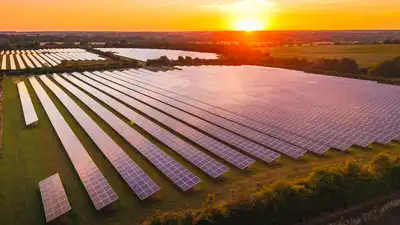
Solar leases offer farmers decades of reliable income, helping secure family finances and keep agricultural operations running.
For Steve Cargil, a 67-year-old farmer whose family has worked the property since 1953, an unlikely source of stability eventually emerged from the changing energy landscape. For generations, the Cargil family has made a living from the wide, dry farmland surrounding Uvalde in southwest Texas. But farming has never offered much certainty. Weather can erase months of work in a single night, while drought, irrigation limits and rising costs can make even a successful harvest difficult to sustain. Scroll down to read the details.
That plan became less certain after a devastating hailstorm in 2018 destroyed cabbage and onion crops that Cargil and his son Ryan had spent months cultivating. The BBC report further explains that Cargil leased 600 acres of his 2,400-acre property to OCI Energy for a large solar installation. The report states that the arrangement now provides him with about $200,000 annually, creating a reliable income stream alongside his remaining agricultural operation. The September 2026 report explains that Cargil’s experience reflects a much larger transformation taking place across Texas. Texas added 15.8% to its population between 2015 and 2025, increasing pressure on its already enormous power system.
Because projects can be developed relatively quickly, while falling technology costs have made large-scale installations increasingly competitive, solar has become attractive. Because utility-scale solar projects require broad stretches of relatively flat land, the report also states that farmers are central to that expansion.
Cargil once expected one of his three children to eventually take over the operation, just as he had inherited the responsibility from his father, according to a BBC report. The loss exposed how vulnerable the family business had become. None of Cargil’s children wanted to farm full time, leaving him to consider not only the future of the property but also his own retirement. The solution came through a portion of the family’s land rather than abandoning farming altogether, adds the BBC report. The lease has become particularly valuable during a prolonged drought. With less land requiring irrigation, Cargil can concentrate his available water resources on the acreage he continues to farm. The additional income also provides a buffer against volatile expenses, including fuel, fertilizer and other necessities, adds the online report. The state has rapidly expanded its solar generation as electricity demand rises alongside population growth. Long-term leases can provide families with predictable income for decades, sometimes helping fund retirement plans, family trusts or continued agricultural operations. The expansion has not been universally welcomed. In parts of rural Texas, residents have raised concerns about the clearing of trees, changes to the landscape, drainage and the presence of large battery-storage facilities. In Franklin County, opponents have pushed back against solar developments and argued that rural communities should have greater influence over where projects are built. Their concerns highlight a growing tension: solar can provide farmers with substantial financial security while simultaneously transforming the countryside that surrounds them. For Cargil, however, the equation is more straightforward. The solar lease has given his family a financial cushion without requiring him to give up the agricultural land that remains central to his identity. The possibility that the farm could eventually reach another generation now seems less remote. What began as an unexpected land-use decision has become a way to keep an old family enterprise standing in an increasingly difficult farming environment. Image Courtesy: istock You use AI every day. Now get your AI Quotient. Take the AIQ test.