Galileo, Jupiter and four moons (AI-image)
In 1610, Italian astronomer Galileo published a small book that challenged the way people understood the universe. Now over 400 years later, the books documenting these opposing views have become part of an extraordinary story of scientific discovery. Rs 2.07 crore book The book was published in Venice in March 1610. Galileo learnt about the development of the telescope in 1609 and later built his own improved instruments. In January 1610, he turned his attention to Jupiter and noticed several points of light near the planet. Sizzi’s Dianoia astronomica, optica, physica, published in Venice in 1611, was bound alongside Galileo’s Sidereus Nuncius in the copy later sold by Christie’s. Four books, one volume and centuries of history Book at Christie’s auction (PC: Christie) The copy sold in 2026 was more than a first edition of Galileo’s celebrated work. Alongside Sidereus Nuncius were three other first editions published in 1611. The volume also contains a reused sheet from a 1474 edition of a Latin translation of Herodotus, incorporated into the inside cover. When the rare volume sold for US$217,600 in 2026, its significance lay in this unusual combination of scientific achievement and intellectual resistance.
Because the two positions survived together in the same physical volume, the disagreement is particularly intriguing. Galileo’s Sidereus Nuncius, commonly translated as The Starry Messenger , announced observations that had become possible through the relatively new technology of the telescope. As he continued observing them on successive nights, their changing positions revealed that they were orbiting Jupiter rather than remaining fixed among the stars. The astronomer who refused to believe However, Francesco Sizzi, a contemporary of Galileo, refused to believe his theory and questioned the existence of Jupiter’s newly reported moons.
Galileo, in turn, declined to refute Sizzi, preferring to preserve their friendship, according to Christie’s catalogue. The works were bound in contemporary stiff vellum boards, according to Christie’s catalogue. Galileo Galilei is a name that needs no introduction. He used a telescope and observed four bodies moving around Jupiter, providing evidence that not everything in the universe revolved around Earth. However, it’s normal that people generally are not convinced with anything that challenges their notion or age-old beliefs. Among those who challenged his findings was astronomer Francesco Sizzi, who argued that the supposed moons were optical illusions produced by the telescope. By the end of that year, he was using them to observe the night sky. It was a significant discovery as it challenged the established Aristotelian picture of the universe. As per his theory, the heavens were understood through a system of nested celestial spheres and Earth occupied a central position. In Sidereus Nuncius, Galileo also described the Moon’s uneven and mountainous surface. It also mentioned that the Milky Way has numerous individual stars that could not be distinguished with the naked eye. Now this book made Galileo famous across Europe. The existence of other bodies orbiting a planet questioned the order in which celestial movements were interpreted. Sizzi argued that the appearances Galileo described could be produced by the telescope itself. The episode offers a glimpse of a time when new scientific observations confronted long-established beliefs, and the debate over evidence was still unfolding. It was a Sammelband, a volume in which separate publications were bound together. The second work was Sizzi’s response to the controversy over Jupiter’s moons. The third, by Marcus Antonius de Dominis, explored vision, light, lenses and the rainbow, with material on the telescope added amid the excitement surrounding Galileo’s discoveries. The fourth, by Giovanni Antonio Magini, explored the properties and effects of spherical concave mirrors. Its binding and surviving details offer a glimpse into how early printed books were assembled and preserved. From a disputed discovery to an astronomical legacy The four moons Galileo observed are now known as Io, Europa, Ganymede and Callisto. Galileo recorded the changing positions of the points of light over successive nights and recognised that their movement was evidence of their orbit around Jupiter. What initially appeared to be an arrangement of distant stars became evidence that celestial bodies could revolve around a world other than Earth. You use AI every day. Now get your AI Quotient. Take the AIQ test.
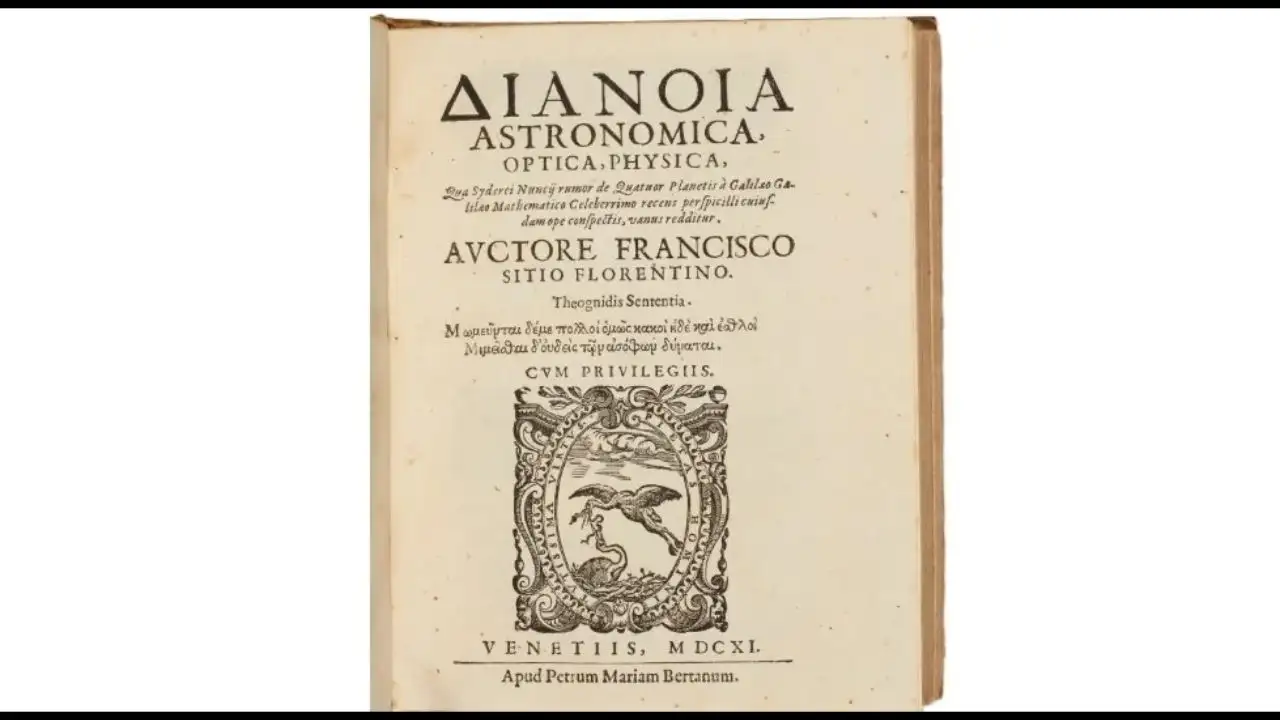
In February 2026, a rare volume containing Galileo’s landmark publication alongside three other early works on astronomy and optics sold at Christie’s for US$217,600, approximately Rs 2.07 crore. It was a collection that was offered as part of the auction house’s sale of fine printed books, manuscripts and science. The little book that changed astronomy Book at Christie’s auction (PC: Christie)