
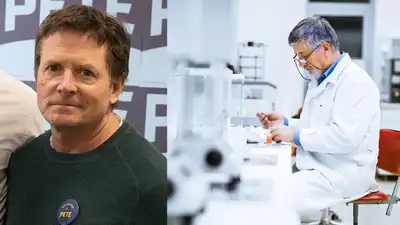
Image: Left/Wikipedia/Right/Michael J. Fox Foundation
Fox Foundation for Parkinson’s Research announced in January 2026 that it had awarded 108 grants totalling $62.4 million in October and November 2025, according to the foundation’s page. As the Daily Mail reported, the actor was promoted to Companion of the Order of Canada, the order’s highest rank, during a ceremony at Rideau Hall in Ottawa on 2 October 2026. His decades-long commitment to the cause provides a wider context for the foundation’s latest $62.4 million investment in research aimed at better treatments and earlier detection.
The foundation says the grants support tools to detect and measure changes in the disease and novel therapies to treat it. Fox, who told the audience at the 78th Primetime Emmy Awards on 14 September 2026, while accepting the Bob Hope Humanitarian Award to a huge ovation, that accepting Parkinson’s did not mean surrendering to it but doing “everything I could for everyone living with this disease,” as Variety reported. Fox has used his foundation, writing and public speaking to advance research and inspire people affected by the condition, according to the Governor General of Canada’s official citation. Such drugs aim to halt or slow the disease process itself, and they remain the greatest unmet need for people living with the condition, according to the foundation.
The Michael J. The foundation’s mission was echoed by its founder, Michael J. Fox’s advocacy also received recognition in his home country of Canada. The honour recognised his global advocacy and openness about living with Parkinson’s disease. A major new initiative, Targets to Therapies, is designed to find out whether specific proteins or genes involved in Parkinson’s disease could serve as effective targets for disease-modifying drugs. In consultation with research experts, the programme selects a subset of promising but understudied targets and funds work that could support clinical testing. Recent awards went to teams studying two of them, a protein that forms channels on cell membranes and may help clear toxic alpha-synuclein clumps, and a gene that senses bacteria and triggers inflammation in the brain and gut, which researchers hope to link to disease progression. Image(s): Wikipedia Alongside target research, the foundation’s Therapeutics Pipeline Program funds biotechnology and pharmaceutical companies to keep promising experimental therapies moving through testing. Recent awards, the foundation reports, include a drug that helps cells replace damaged mitochondria with healthy ones and another that improves lysosomal function to reduce toxic alpha-synuclein buildup, both aimed at slowing the disease. Further grants support drugs designed for genetic forms of Parkinson’s disease, one reduces overactivity of a protein linked to a gene mutation, and another aims to improve cellular cleanup disrupted by a separate mutation. Symptoms are covered too. One grant supports a drug to improve the thinking abilities that underlie apathy, a common symptom that reduces motivation, and another supports real-world data collection for a hip-powered robotic device that aims to improve balance and walking.

Earlier detection of Parkinson’s disease: Blood, urine and skin oil biomarkers plus brain imaging
The foundation notes that a 2023 discovery, supported by its research funding, produced a spinal fluid test able to detect misfolded alpha-synuclein in living people even years before outward symptoms. In 2025, the foundation announced sixty-nine grants totalling 60.6 million dollars awarded in April and May 2025. The latest round therefore includes thirty-nine more grants and about 1.8 million dollars more in funding.
The foundation says tools that visualise alpha-synuclein in the living brain would transform research and care. Researchers all around the world are racing to understand Parkinson’s disease well enough to slow it, stop it or catch it before symptoms take hold. The Michael J. Fox Foundation for Parkinson’s Research has put sixty-two point four million dollars behind that race, awarding one hundred and eight grants in a single two-month window. Read on to see where the money is going, which projects stand out and how it compares with the previous round. Recent grants now explore other samples, tools aiming to find early signs in blood and urine, and a project characterising a biochemical fingerprint in sebum, the oily substance produced by skin. Imaging is a priority as well. Funded work includes a next-generation magnetic resonance imaging tool, a search for positron emission tomography tracers that bind tightly to alpha-synuclein without sticking to the wrong brain proteins, and two studies using a high-resolution PET camera called NeuroEXPLORER. The previous round gives useful context. You use AI every day. Now get your AI Quotient. Take the AIQ test.
The funding stretches from experimental drugs and new biological targets to blood, urine and skin tests, and brain scans that could reveal the disease earlier. Detecting Parkinson’s disease earlier is the second major thread. That earlier round also highlighted research powered by the Parkinson’s Progression Markers Initiative, which the foundation describes as the largest natural history study of people with the disease worldwide, with more than seven hundred sixty thousand banked biosamples.