
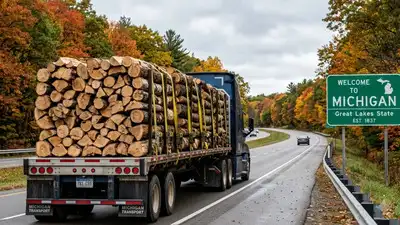
Michigan will allow firewood from outside the state only if it is properly treated to eliminate insects and pathogens. (AI photo)
A new rule in Michigan bans untreated firewood brought from outside the US state starting January 1, 2027. The restriction is intended to prevent the introduction of more than 140 plant pests and diseases. repeat offenders could face fines ranging from $1,000 to $10,000 from 2028 While the first year will focus on awareness. Emily Silver, from Michigan State University’s Forestry Department, told WILX News 10 that the emerald ash borer had killed an estimated 60% to 75% of ash trees across Michigan. For certification, the temperature at the centre of the wood must reach at least 140 degrees Fahrenheit and remain there for 60 consecutive minutes. People bringing untreated firewood into Michigan will be subject to the new restrictions from January 2027. From January 1, 2028, violations will lead to warning letters, while repeated violations may attract fines of $1,000 to $10,000. People who voluntarily report violations may face penalties of up to $500. Their advice is to buy it close to where it will be burned, preferably within 10 miles, and leave any unused wood at that location rather than carrying it elsewhere.
The Michigan Department of Agriculture and Rural Development (MDARD) announced the quarantine last month, alongside the Michigan Invasive Species Program. Michigan has separately introduced a voluntary Invasive-Free Firewood Certification Program.
In the official statement, the state said the rule will apply to everyone bringing firewood across the state’s borders, including campers, travellers and businesses. “It’s sort of like human beings: anything that causes stress to the organism makes it a lot less resilient to other things that happen,” Silver told WILX. It allows producers within the state who meet the treatment requirements to display a “Certified Invasive-Free” seal on their firewood.
A piece of firewood may appear harmless, but insects and plant diseases can remain hidden inside it and travel to new places when the wood is moved. Firewood that has received approved heat treatment and carries the required certification will continue to be permitted. The difficulty with identifying contaminated firewood is that harmful organisms are not always visible. Insects may remain beneath the bark or deep inside the wood, while some diseases leave no obvious signs. This means that even firewood that looks normal could carry organisms capable of affecting trees elsewhere. State officials say preventing their introduction is more effective than trying to control them after an infestation has developed. Michigan has already experienced the damage invasive insects can cause. One example is the emerald ash borer, an insect associated with extensive tree mortality in the state. The problem extends beyond the immediate damage caused by insects. Trees weakened by an infestation may also become less capable of surviving other environmental pressures. Other organisms of concern include the Asian longhorned beetle and spotted lanternfly. Michigan’s new rule does not prohibit all firewood brought from outside the state. Instead, it requires imported firewood to undergo a treatment process designed to eliminate insects and pathogens. The treatment must also be recognised by MDARD, another state’s agriculture department or the US Department of Agriculture. Simply drying firewood in a kiln will not necessarily satisfy these conditions. it does not establish that the wood has reached the required internal temperature for the specified duration Although drying removes moisture. Some wood products are excluded from the quarantine. These include kiln-dried dimensional lumber, wood pellets and wood chips no larger than one inch in two dimensions. Certain untreated wood products sent directly to approved processing facilities are also exempt. However, enforcement during that year will primarily involve informing the public about the requirements. MDARD will work with the Michigan Department of Natural Resources on the implementation. The authorities are also asking people to change how they purchase and use firewood. Michigan is not the first US state to impose restrictions on firewood movement. Minnesota, New York and Wisconsin have similar requirements concerning certified, heat-treated firewood entering their borders. However, the new Michigan quarantine deals specifically with wood arriving from outside the state. Silver has also raised concerns about movement within Michigan, pointing out that transporting wood between places such as Detroit and the Upper Peninsula could spread harmful organisms. You use AI every day. Now get your AI Quotient. Take the AIQ test.