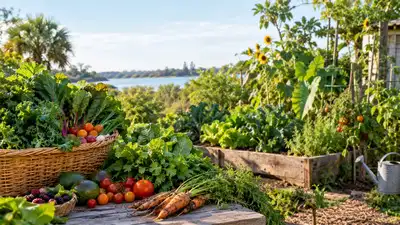
AI Representation: A garden with raised beds and freshly harvested vegetables, illustrating a food-growing setup in Florida. Image credits: Chatgpt
From November 11, 2018 to November 11, 2019, activist Rob Greenfield set out to see whether he could meet all of his food needs by growing or foraging for everything he ate. WUSF described how, for 365 days in Orlando, Florida, he avoided grocery stores, restaurants, takeout and food prepared by friends. He completed the project in November 2019 and later documented it in the book Food Freedom : A Year of Growing and Foraging 100 Percent of My Food , as noted in National Geographic’s profile of Rob Greenfield. Food Freedom project, November 11, 2018 to November 11, 2019 National Geographic reported that Greenfield learned which plants worked well in Florida by talking with local growers, visiting community gardens, attending classes, watching YouTubers and reading books about local and native flora. Greenfield relocated from San Diego to Orlando for the project, where the nonprofit Orlando Permaculture provided support, according to a January 2022 WUSF profile. With no land of his own in Florida, Greenfield built a 100-square-foot tiny house from repurposed materials in the backyard of Orlando herbalist Lisa Ray, who offered him the space. He grew over 100 foods in his garden and over 200 foods in nature, including medicinal herbs and vitamins, according to Greenfield’s page on the project. The study Monitoring and mitigation of toxic heavy metals and arsenic accumulation in food crops: A case study of an urban community garden, published in Plant Direct in January 2020, repeatedly tested fruits and vegetables over four years at the Ocean View Growing Grounds community garden, on a formerly contaminated brownfield site in southeastern San Diego. Swiss chard grown directly in the ground contained arsenic at 0.80 mg/kg dry weight, while lettuce contained 0.42 mg/kg. Strawberries contained lead at 0.84 mg/kg dry weight. Over the four-year sampling period, lead in the leaves of Black Mission fig trees measured 0.843 to 1.531 mg/kg dry weight, and in Mexican lime leaves 1.103 to 1.522 mg/kg dry weight, the study authors reported.
When the raised beds made of uncontaminated soil were introduced, there were no detectable levels of heavy metals and metalloids in the crops.
Project rules: no packaged, processed or shipped food Nothing packaged, processed or shipped became part of his food intake, according to the book’s summary. Even vitamins and supplements were excluded. The only thing he consumed but did not swallow was toothpaste, as he explained in an interview with WUSF. Tomatoes and Brussels sprouts showed no detectable levels of heavy metals or metalloids.
He explained that this preparation, done before the project began, took him from knowing little about growing food in the region to being able to grow and forage all of his food.