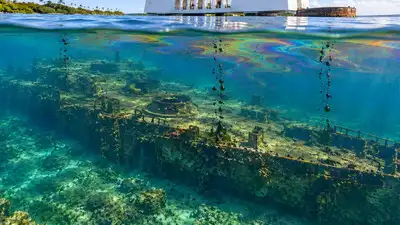
A wartime wreck that never stopped seeping (representative image). Image Credits: ChatGPT
The USS Arizona, which sank at Pearl Harbour, Hawaii, still leaks oil 80 years later, according to the Woods Hole Oceanographic Institution . Researchers believe that 600,000 gallons of oil still remain on the ship. Image Credits: Wikimedia Commons What the oil samples showed The team analysed oil collected by the National Park Service in 2016 and 2018. The Marine Pollution Bulletin study described the oil as chemically complex after more than 75 years underwater at the time of sampling in 2016 and 2018.
The good thing about the situation is that the oil is not leaking at a highly concerning rate, according to Chris Reddy, a marine chemist at Woods Hole and one of the authors of the study. The lead author of the University of Houston paper, the oil changes even before it leaves the vessel, according to Jagoš Radović. Reddy said the decision to remove oil is a balance of the risk of a spill and the risk of disturbing the wreck. Sometimes, he said, it is better to watch closely than to step in.
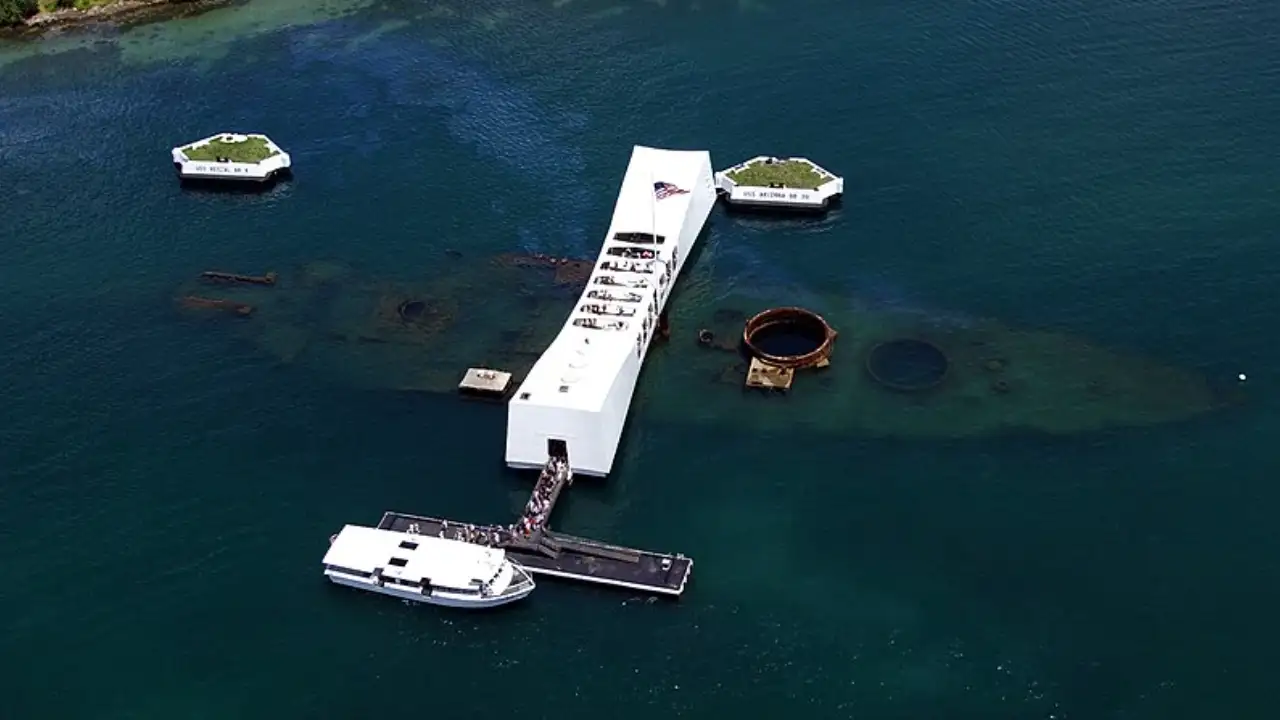
Some scars from the Second World War simply refuse to disappear. Research from the institution and the University of Houston led to a new study in Marine Pollution Bulletin that analysed oil samples from several leak points on the wreck. They found that the oil isn’t the same in all places. The work also has lessons for thousands of other Second World War wrecks around the globe. Why this wreck is so tricky The Arizona isn’t just another shipwreck. It is also a war grave and a memorial site, so any work there needs to be done with care and respect. David Conlin, a marine archaeologist with the National Park Service, noted that this particular site requires nothing less than the best and most careful science possible. The scientist also emphasised that the research team took a respectful and non-intrusive approach to collecting data. That’s a lot of oil to have sitting in one place for over eight decades. Yet the research emphasises the need for ongoing monitoring and preparedness at the site. An aerial view of the USS Arizona Memorial at Pearl Harbour, Hawaii, built over the wreck of the battleship. They used advanced molecular fingerprinting, which maps the composition of an oil and where it likely came from. Testing showed it was a heavy fuel oil refined from California crude. This is the type of fuel the US Navy used to fuel its ships in the early 1940s. The oil still has high levels of polycyclic aromatic hydrocarbons (PAHs). These compounds are known to be long-lived and can be toxic. However, Reddy noted that not all of the PAHs found here are highly toxic. Why every leak has its own fingerprint The oil was initially the same fuel, but its chemistry changes depending on leaks. it comes across different oxygen content, water flow, and microbes that create a unique chemical signature for each leak While moving through the network of wreckage. Natural weathering is also a big factor, with microbes breaking the oil down and some of it dissolving in water. Lighter compounds gradually disappear while the biomarkers stay intact. This allows scientists to trace where the oil came from and how it changes over time. What it means for other shipwrecks The Arizona is not alone. The ocean floor is littered with thousands of wrecks from World War II, holding millions of gallons of unrecovered fuel. Many are sitting near the shore. The Arizona is giving scientists a rare chance to watch over decades how oil behaves in low-oxygen water, which may inform plans for future spills. The amount of oil remaining, the rate of leakage, the local ecosystem and the wreck’s historical significance all matter. The same paper also noted that war graves should not be disturbed by aggressive or intrusive means. You use AI every day. Now get your AI Quotient. Take the AIQ test.