
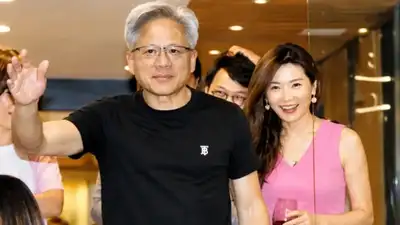
File photo: Nvidia CEO Jensen Huang and Alice Huang
Nvidia’s board, which includes Aarti Shah, an Indian-origin veteran from Eli Lilly, has launched an independent investigation into whether its 63-year-old chief executive was targeted by a foreign intelligence operation. The flap comes at a particularly awkward time for the two countries, with President Trump scheduled to meet the Chinese president Xi Jinping next week (on November 18-19) on the sidelines of the Asia-Pacific Economic Cooperation (APEC) gathering in Shenzhen, a city that is emblematic of China’s own technological ambitions. TOI correspondent from Washington: China has been chipping away at American technological primacy for years. Now, if US intelligence suspicions are borne out, it may have found a rather intimate way of getting close to the crown jewels of America’s AI empire – seducing its top chip honcho, Nvidia’s Jensen Huang, in a honeytrap operation worthy of a spy thriller. The allegations are explosive, although they remain unproven. Beijing has denied the allegations, saying they are “nothing but smears against China.
Megaspeed bought more than $4.8 billion worth of Nvidia chips over two years, according to industry reports. In fact, by Huang’s own account, his first meeting with PM Modi was in 2018 when the Indian PM surprised him by inviting him to speak directly to the Indian Cabinet about the future and importance of artificial intelligence long before AI became a mainstream global discussion. House Foreign Affairs Committee chairman Brian Mast, China Select Committee chairman John Moolenaar and Intelligence Committee chairman Rick Crawford have asked Huang to brief them behind closed doors on November 18 about the allegations and Nvidia’s safeguards against foreign espionage.
Because southeast Asia is seen as an important transit point in the suspected diversion of advanced American chips to China, where their sale is restricted by Washington, its position in the regional semiconductor supply chain is particularly sensitive.
Asked about Huang’s relationship with the alleged Chinese spy, Trump told reporters on Air Force One that the Nvidia chief is an “honorable guy” who has done an “amazing job for our country” and he probably has as “excuse” that needs to be heard. I just know he’s a fine person, but you never know what is going on,” Trump said, while appearing to give him the benefit of doubt by asserting Huang should remain Nvidia CEO and he would probably take him on his Asia trip. Its initial statement was carefully calibrated: it had “no reason to believe” that either American national security or Nvidia’s secrets had been compromised, but would examine all available information.
“I have not spoken to him about it. Huang, meanwhile, has admitted to an affair with a business executive identified as Alice Huang, whom US intelligence officials reportedly believe was collecting information for China. In a message to Nvidia employees, he wrote: “I was unfaithful to my wife. My actions hurt her and our children. There is no excuse for what I did. I am deeply sorry. US intelligence officials reportedly concluded that Alice Huang had been recruited by Chinese intelligence to cultivate a relationship with Jensen Huang, obtain information, and potentially influence access to Nvidia’s advanced processors. The precise nature of the information allegedly sought, and whether anything of strategic value was actually obtained, remain unclear. Jensen Huang himself has consistently argued that completely shutting China out of the US semiconductor ecosystem is strategically counterproductive. He has lobbied Trump to permit sales of less advanced Nvidia products to Chinese customers, arguing that American companies should not surrender the world’s largest technology market to domestic Chinese competitors. The lobbying has had some success, with Trump allowing Nvidia to sell H200 processors to China under a revised export framework. The Nvidia board meanwhile has appointed a committee of independent directors, assisted by outside legal counsel, to examine the matter. It also expressed confidence in Huang and his leadership team. On his part, Huang has pledged full cooperation with the board’s investigation, declaring his commitment to protecting Nvidia and supporting American national security. He also described himself as proud and grateful to be an American. Huang is not just another corporate CEO; he is Nvidia’s chief strategist, chief salesman, and public face of the AI revolution. His leather jacket has become almost as recognisable in technology circles as the company’s green logo and his ability to navigate Washington – where he has had conspicuous access to President Trump – Silicon Valley and Asian technology markets has been central to Nvidia’s extraordinary rise. He has also met PM Modi several times, most recently at the Nvidia’s multi-day AI summit in Mumbai last month. Meanwhile, US lawmakers in Washington, chuffed by mid-term elections results that have significantly dimmed executive primacy, are already demanding answers. The coincidence of that proposed briefing with the approaching Trump-Xi encounter adds another layer of awkwardness to the meeting between the two leaders that was already visible when Xi came on a state visit to Washington DC late September. You use AI every day. Now get your AI Quotient. Take the AIQ test.
Alice Huang, also known as Huang Le, is a former television journalist in China who subsequently is said to have reinvented herself as a semiconductor industry power broker. She became a senior executive at Singapore-based Megaspeed International, a data-centre company that emerged as one of Nvidia’s biggest customers in Southeast Asia. All this places Huang in an unusual position: he is simultaneously America’s most important AI industry champion and one of the most influential corporate advocates for retaining access to China. The espionage allegations now threaten to complicate that balancing act considerably.