
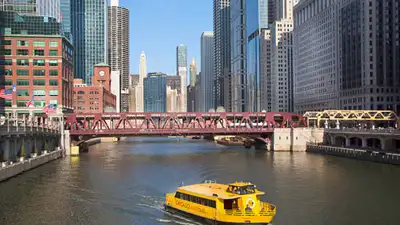
Chicago’s founding problem had always been plumbing. The city drew its drinking water from Lake Michigan and emptied sewers into the Chicago River, which flowed straight into Lake Michigan. But every rainstorm flushed the stockyards and slaughterhouses and a million people’s waste out toward the water intakes. This is why the nineteenth-century city was periodically ravaged by typhoid, cholera, dysentery and more. This is when the city came up with a solution: if the river ends in the wrong place, turn it around.
On the frigid morning of January 2, 1900, with almost no announcement, they went out to the last earthen dam at Kedzie Avenue and had it cut; one account has trustees attacking the final barrier themselves as the water broke through. By January 17 the controlling works at Lockport were opened and the reversal was fact.
A fisherman’s line of that season put it best: the Chicago River had become “the only river in the world that flows away from its mouth.” Downstream, the plan had been received with understandable horror. Missouri, whose largest city, St. Louis, drank from the Mississippi, saw Chicago preparing to point its sewers at their faucets, and prepared to ask the U.S. Chicago’s sanitary trustees, hearing the lawsuit was coming, chose velocity. Missouri filed within weeks, but there was no longer a construction project to enjoin, only a river already running backwards.
Supreme Court for an injunction before the canal could open.
In 1906, Justice Oliver Wendell Holmes delivered the Court’s answer: Missouri had failed to prove that Chicago’s distant, diluted sewage was what sickened St. Missouri pressed the case anyway, and Missouri v. Illinois became a landmark. Louis, a burden made harder to carry by the awkward fact that St. Louis and every city between were pouring their own raw sewage into the same rivers. The suit failed; the reversal stood. The case, in the process, helped found the federal common law of interstate pollution, the legal machinery later used against actual proven polluters.