
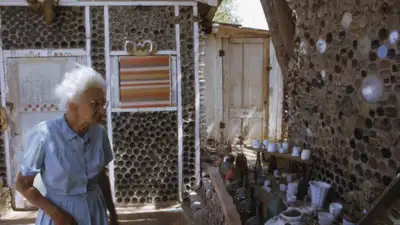
When Tressa Prisbrey was 60 years old, she wanted to build a small shed for her large pencil collection. In 1956, she found that concrete blocks cost more than she could afford. Over the next 25 years, she turned a one-third-acre lot in Simi Valley into Bottle Village, a well-known folk-art site with 15 structures, shrines, mosaic paths and sculpture gardens.
The non-profit organisation that looks after the site, the project began soon after Prisbrey and her husband parked their trailer on Cochran Street, according to historical records kept by Preserve Bottle Village. Rather than give up, the California resident began collecting thousands of discarded glass bottles and household items from a nearby landfill. After buying the land, she had little money left for building materials, so she turned to a local dump to find glass bottles.
Other buildings included the Doll House, which held more than 600 dolls she had rescued from being thrown away. In 1974, architectural critic Esther McCoy discussed the site’s cultural importance in an essay for a catalogue published by the Walker Art Centre in Minnesota. Bottle Village received official recognition in 1981, when it was named California State Historical Landmark No. 939. In 1996, it was added to the National Register of Historic Places. She died in 1988 at the age of 92. Ownership of Bottle Village had been transferred to Preserve Bottle Village in 1986. The site received further recognition in 2025, when it became an affiliate member of Historic Artists’ Homes and Studios.
Because of her declining health, prisbrey moved to San Francisco in 1982.
“At the root of her uniqueness is a divine disorder; she has a passion for all discarded objects and shows a willingness to provide them all, equally, a place in her scheme,” McCoy wrote in her analysis of Prisbrey’s work. Official site records show that three were called Pencil Houses, where she displayed thousands of pencils. Once she ran out of space to build more structures, Prisbrey began decorating almost every available part of the property. She made mosaic paths from broken tiles and crockery, created a headlight garden from old car parts, and built shrines using seashells, horseshoes and discarded household items. Prisbrey never considered herself a professional artist, but her work gained wider attention in the art world during the 1970s. It was later designated a Ventura County Cultural Landmark and a Simi Valley City Landmark. The national programme is managed by the National Trust for Historic Preservation and recognises places connected to artists and their work.