
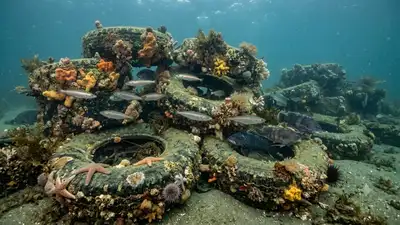
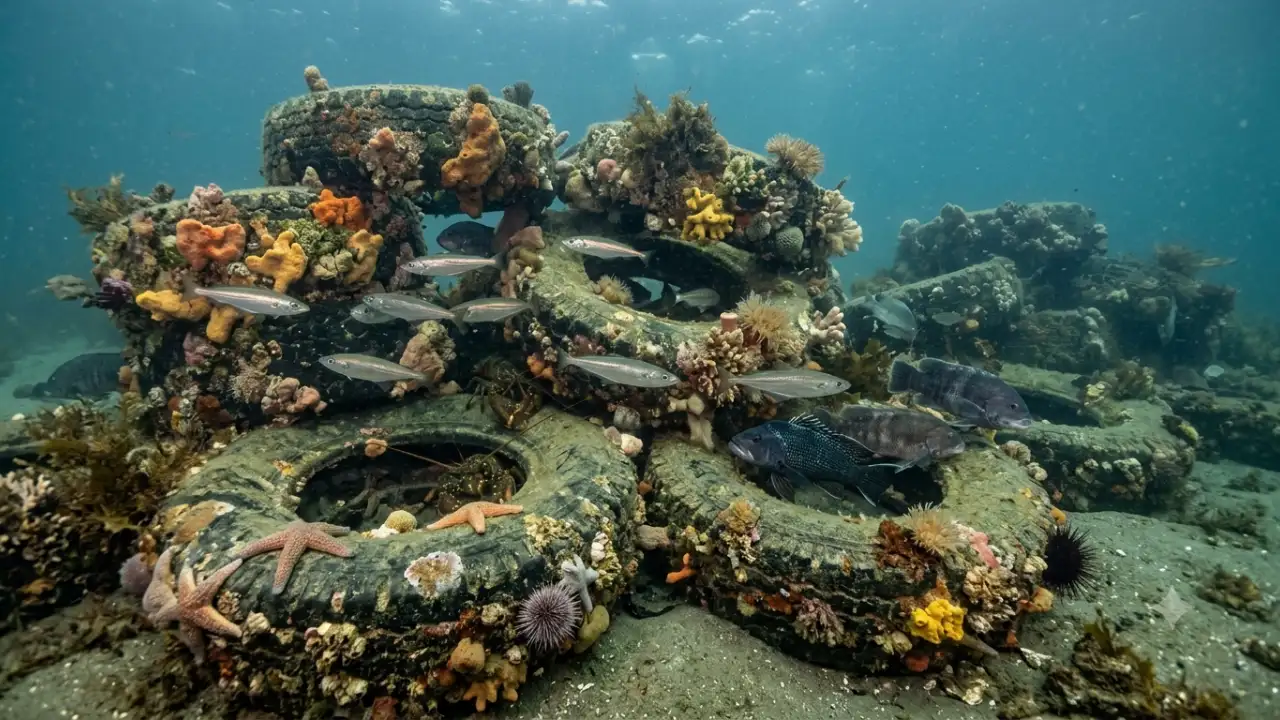
Off Yarmouth, Massachusetts, the unusual structures form part of an artificial reef that has been developing in Nantucket Sound since 1978. Over time, the reef expanded to roughly 2,500 original units across 127 acres, while later additions brought in concrete and granite. Surveys in 2019 gave researchers another way to measure its effect, revealing a striking difference in how quickly fish reached structured reef habitat and bare sand.
A pile of concrete-filled tyres may not look like much from above, but beneath the surface it can become something very different. The project was designed to introduce physical complexity to a sandy seabed and provide habitat for fish and lobsters.
About 1,500 units went into the water in 1978, followed by another 1,000 in 1994, bringing the total to roughly 2,500. Surveys conducted by the Division of Marine Fisheries in 2009 and 2010 used side-scan sonar and divers to examine the site. In a 2019 survey, researchers compared the Yarmouth reef with another artificial reef, a natural reef and an area of relatively featureless bottom.
The Yarmouth reef was developed by the town’s Department of Natural Resources with assistance from the Division of Marine Fisheries. It became the first permitted artificial reef of its kind in Massachusetts and was positioned more than two miles south of the mouth of Bass River. The original units were relatively simple. Three to five tyres were filled with concrete and fastened together in bundles, creating a low structure above the seabed. The aim was to introduce physical complexity into an otherwise relatively featureless stretch of bottom, giving fish and lobsters places to shelter and move around. Massachusetts’ artificial reef programme describes such structures as deliberately placed habitat for fish, with potential benefits for fisheries and recreational fishing. They found little evidence of reef material moving outside the permitted area. The northern part of the site contained the highest concentration of deployed material, while fish numbers were also higher where more reef structure was present. Scup and black sea bass were among the fish found in substantial numbers. The structures were being managed as habitat. The Massachusetts artificial reef programme uses surveys, diving and remote sensing to track how these sites perform and how marine communities develop around them. Underwater video cameras were used to observe fish arriving at the different sites.
Finfish appeared on camera after an average of about 33 seconds at reef sites, compared with 502 seconds at the bare control. That is roughly eight minutes and 22 seconds over the unstructured seabed. The study calculated that fish appeared on reef sites 93.4% faster than at the bare control. The original 1978 deployment was not the end of the project. In 2014, the town and the Division of Marine Fisheries received permits to add further reef material in parts of the site where surveys had identified lower concentrations of existing structures. More material was added again around 2019 and early 2020. More than 3,000 cubic yards of new material were involved across the two deployment efforts. A Massachusetts habitat-enhancement project, for example, used more than 2,200 cubic yards of material to create additional structured habitat within an undeveloped part of the permitted reef area.
The reef therefore became more than a collection of objects placed underwater. The contrast was striking in terms of arrival time, without needing a dramatic interpretation. The result did not mean every reef was identical. The study also measured species richness and diversity at Yarmouth, Harwich, a natural reef and the bare control. Black sea bass and scup were among the species recorded across the sites, while the researchers found differences in the composition of fish communities depending on the location and reef age. The value of an artificial reef comes partly from the spaces created around and between its structures. A flat sandy bottom offers relatively little vertical relief. Bundled structures create edges, gaps and surfaces where animals can shelter, feed or attach themselves. The Yarmouth site has been associated with a range of marine life, including black sea bass, scup, tautog, summer flounder, winter flounder and lobsters. Other species recorded on the reef include blue mussels, cunner, butterfish, longfin squid and knobbed whelk. Over time, marine organisms colonised the available surfaces, while fish used the added structure as part of the surrounding habitat. This included retired concrete buoy sinkers from the US Coast Guard, granite blocks recovered from demolition projects and other concrete material. The later additions also changed the character of the reef. Rather than relying only on the original tyre bundles, the site began incorporating approved construction and infrastructure materials that could provide similar physical relief. Catch the latest World News and Live updates. Download the TOI app.
Massachusetts’ artificial reef planning documents describe earlier monitoring at Yarmouth as showing stabilisation of the structures, colonisation by marine organisms and increased recreational fishing activity.