
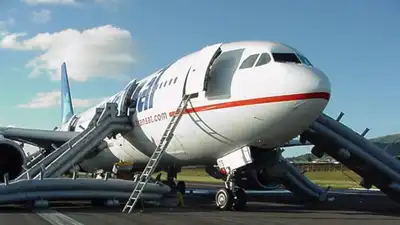
A routine transatlantic journey from Canada to Portugal became a fight for survival when an Air Transat passenger jet lost both its engines over the Atlantic Ocean in August 2001. All 306 people aboard survived the emergency landing, although several passengers and crew members were injured. The incident, involving Air Transat Flight 236, later became known as the Azores Glider and remains one of the most remarkable examples of an unpowered passenger aircraft landing.
CBC News and the Aviation Safety Network, the Airbus A330 ran out of fuel because of a leak that developed during the flight, according to the Portuguese aviation accident investigation report. With no engine power and land still some distance away, Captain Robert Piché and First Officer Dirk DeJager had to guide the aircraft towards an airport in the Azores, relying on the plane’s ability to glide.
At 5.45 UTC on August 24, the pilots decided to divert to Lajes Air Base on Terceira Island in the Azores, a Portuguese archipelago in the Atlantic. At 6.13 UTC, the right engine stopped after running out of fuel. The aircraft was still approximately 150 nautical miles from Lajes. The crew continued descending towards the island, but the situation deteriorated further when the left engine also shut down at 6.26 UTC, leaving the aircraft without any engine power. All 306 people survived, although 16 passengers and two crew members sustained injuries, including two passengers who were seriously injured but not in a life-threatening condition. In 2002, Piché received the Air Line Pilots Association’s Superior Airmanship Award in recognition of his handling of the emergency. The incident also became the subject of documentaries, aviation programmes and the 2010 Canadian biographical film Piché: The Landing of a Man, which depicts the captain’s life and the events surrounding Flight 236. Its 65-nautical-mile unpowered journey demonstrated the importance of cockpit coordination, emergency decision-making and the ability of flight crews to respond under extraordinary circumstances.
By the time the pilots recognised the seriousness of the situation, a substantial amount of fuel had already been lost. A subsequent fuel imbalance warning prompted the crew to transfer fuel between the aircraft’s tanks. However, the procedure inadvertently sent more fuel towards the leaking engine, accelerating the loss. With both engines out, the Airbus became a glider. Its emergency ram air turbine automatically deployed, providing enough electrical and hydraulic power to operate essential flight controls and instruments. However, several other systems, including the normal braking and flap systems, were no longer available. The emergency evacuation began immediately. The aircraft itself suffered substantial damage to its landing gear and lower fuselage. An investigation led by Portugal’s Aviation Accidents Prevention and Investigation Department, with assistance from the Transportation Safety Board of Canada, examined the circumstances behind the incident. Investigators traced the fuel leak to a maintenance error involving incompatible parts fitted during the replacement of the aircraft’s right engine. A hydraulic line had been installed too close to a fuel line, allowing the two to rub against each other during operation. The friction eventually caused a crack in the fuel line, through which fuel escaped. The successful landing brought international attention to Piché and DeJager. Often remembered as the Azores Glider, the flight remains a landmark in commercial aviation.
Air Transat accepted responsibility for the maintenance-related failure and was fined C$250,000 by Canadian authorities in September 2001. The investigation also identified shortcomings in how the cockpit crew interpreted the fuel warnings and responded to the imbalance. Their decision to follow the fuel imbalance procedure without recognising the possibility of a leak contributed to the loss of fuel. The accident also prompted changes to aircraft operating procedures and fuel-leak warnings to help prevent similar incidents.