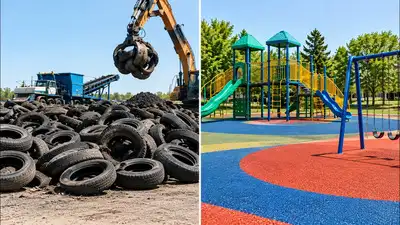
Representative image of discarded scrap tyres being recycled into safe playground surfaces. Image Credit: ChatGPT.
In 2009, a state-funded recycling programme in Nebraska took a different approach, treating discarded tyres as a source of usable rubber rather than waste. The state made funds available in 2009 to clean up 11,605 tons of scrap tyres from individuals, farms and businesses, according to the Nebraska Department of Environmental Quality . The programme was part of more than $2.5 million in grants supporting 126 tyre collection and recycling projects across Nebraska. Nebraska charged a $1 fee on each new tyre sold in the state, with the money directed towards waste reduction and recycling grants. In 2009, the grants were intended not only to remove accumulated tyres but also to help communities purchase products made from recycled tyre rubber. In Nebraska, according to the environmental agency, the number of scrap tyres produced each year exceeded 1.5 million tyres. Sixty political subdivisions had planned to conduct scrap tyre collections in 2009 using the money allocated.
Because the programme was not meant to prove that tyre rubber outperformed road materials in every case, this mattered. A worn-out tyre usually has little value once it is removed from a vehicle. Left in piles, however, old tyres can occupy large amounts of space and create problems of their own. The collected tyres were to be processed into crumb rubber for playground surfaces, running tracks, artificial turf and rubber-modified asphalt, while some were also processed into larger shreds for other applications. The programme was supported by a simple funding mechanism. The problem was significant. It was almost equal to one tyre per capita of the people living in Nebraska. The grants aimed to address two problems at once: collecting waste tyres and creating markets for the material they contained. This allowed tyres from households, farms and businesses to enter the recycling process. Officials described the project as a continuation of their assessment of rubberised asphalt on Nebraska roads. It was a test to see if a material that had served one purpose could be used in another structure.