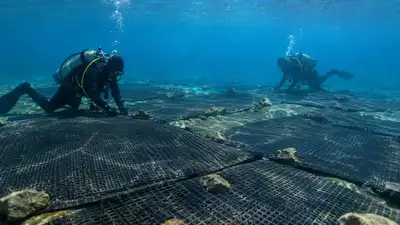
Representative image of underwater mats being placed across a lakebed for invasive species control. Image Credits: ChatGPT.
Asian clams (Corbicula fluminea) were first discovered along Lake Tahoe’s south shore in 2002, according to the UC Davis Tahoe Environmental Research Centre . In 2010, scientists from UC Davis and the University of Nevada, Reno covered Asian clam beds at another Lake Tahoe site with artificial rubber sheets to deprive the clams of oxygen. The results were more than 98 per cent mortality after the removal of these sheets, and the density of clams was 90 per cent less than the control area even after one year. In October 2012, UC Davis scientists prepared 238 rolls of rubber barrier, each 100 feet long and weighing about 300 pounds. The material was reinforced with roughly 10 miles of rebar and 16,000 grommets, while valves were incorporated into the barriers so divers could collect water samples from beneath them without removing the material. By the time the physical obstacles were removed in 2014, the project had been carried out on approximately 5.5 acres in Emerald Bay. Preliminary results showed a mortality rate of 90 per cent among the Asian clams.
Because the population was small and isolated, scientists saw a chance to control it before it became harder to manage. UC Davis therefore had to monitor conditions under the mats rather than assuming that simply covering the clams would be enough. Because the scientists exploited one of the clams’ survival requirements, the technique worked.
The Emerald Bay treatment was only one part of a broader strategy, according to UC Davis. Within several years, the non-native bivalves had reached densities of thousands of clams per square metre in some locations. The clams could affect native invertebrates, benthic habitats and nutrient cycling, and their activity could also add nutrients that encourage algae growth. The problem was particularly concerning in Emerald Bay, where researchers found an isolated population on a shallow gravel sill near the entrance to the bay. Researchers had already tested the idea on a smaller scale. Research published in Environmental Management examined the use of gas-impermeable benthic barriers to create oxygen-depleted conditions around Asian clams in Lake Tahoe. The study found that artificially creating anoxic conditions could provide an effective non-chemical method for controlling the invasive bivalves. The Emerald Bay project was far larger. The barriers were then readied for placement across about five acres of lakebed in Emerald Bay. Emerald Bay’s entrance experiences strong currents, which could move or overturn the barriers. The lakebed was also made up of porous and uneven glacial material, allowing oxygen-rich water to move through the sediment beneath the barriers. The barriers remained in place far longer than the initial treatment period. Data collection included taking sediment samples as well as monitoring oxygen levels, nutrient loads, and the impact on the clams and other creatures. The result did not eliminate the species from Lake Tahoe. The difficult conditions in Emerald Bay allowed some clams to survive, and the larger Lake Tahoe population continues to pose a management problem. Instead of adding chemicals to the water, the barriers changed the local microenvironment. By isolating the water from the oxygen-consuming sediment, the area beneath the rubber became less suitable for the clams. However, there was an issue associated with the use of the technique. The treatment affected not only the invasive species but also non-target benthic organisms. Any evaluation of the technique had to consider both its effectiveness against the invaders and its impact on the lakebed ecosystem. This trade-off may have been one of the reasons why this solution was applied to a smaller area with a limited infestation of clams rather than the whole lake. Laying the rubber on the lake bottom was labour-intensive and costly, and it had to withstand currents long enough to create lethal conditions for the clams. The experiment showed that invasive clams can be controlled without chemicals. It looked like a patch of clear water, but beneath the surface hundreds of rolls of rubber were laid on the lakebed, held down, monitored and studied to deprive the clams of oxygen.
The underwater setting made the larger experiment much harder than the earlier trials.