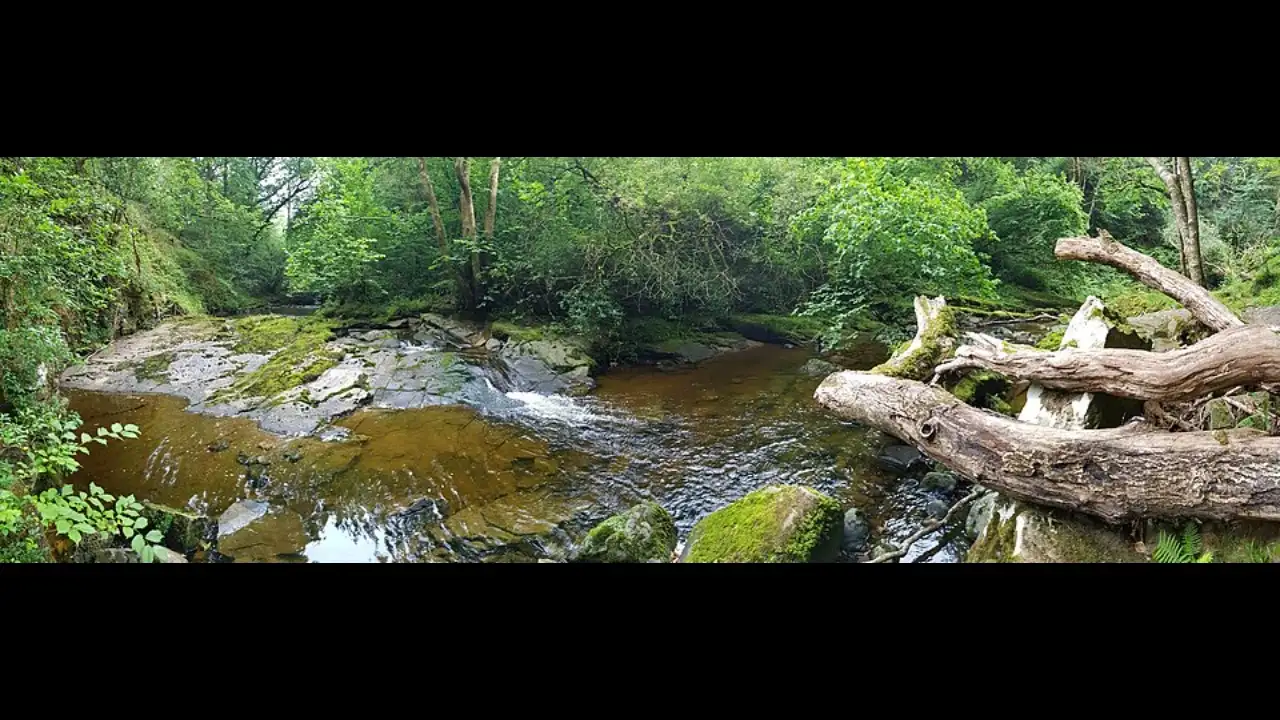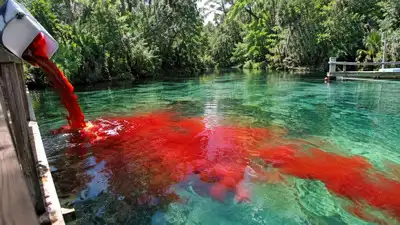
Representation of a dye tracer spreading through a clear spring-fed river, illustrating how scientists can visualise the movement and mixing of water. Image Credits: ChatGPT.
In 2015, researchers used a fluorescent dye to trace the movement of water through the Silver River, one of Florida’s major spring-fed waterways. The 2015 dye-tracing experiment was part of a broader research effort examining changes in Florida’s spring ecosystems, according to the University of Florida’s Center for Wetlands and Stream Ecosystem Research . The 2015 results showed that the dye travelled the roughly 5.1-mile monitored reach in about 11.5 hours, according to the project’s reported results. That works out to an average travel rate of about 0.44 miles per hour, although the dye did not move at the same rate throughout the river. Researchers later compared the 2015 results with those from another Silver River tracer experiment carried out in 2009.
Because the tracer can be detected at successive points along a river, fluorescent dye tracing is commonly used to study the movement and mixing of water. The experiment was designed to measure how quickly water travelled through the river, how it mixed along the way and how long it remained in different sections. These included a shift from clear-water conditions dominated by submerged aquatic vegetation towards greater algal growth. Researchers were investigating how changes in river hydraulics and nutrient movement might be related to these ecological changes. In the Silver River, the method allowed researchers to follow the same water signal downstream rather than relying only on measurements taken at individual locations. A University of Florida Water Institute study found that the river’s hydraulic behaviour changed under different discharge conditions. At higher discharge, the mean residence time of the spring run decreased, while transient storage increased. In practical terms, this means that changes in river flow can affect both how quickly water travels downstream and how much water temporarily exchanges with slower-moving areas along the channel. Such changes can, in turn, influence how nutrients and other substances move through the river. The Silver River experiment formed part of a larger three-year interdisciplinary research project funded by the St Johns River Water Management District. Ten University of Florida researchers from four departments contributed to the programme, which examined the causes of ecological change in Florida’s springs and possible responses. The tracer experiment focused on how water moved through the Silver River, providing measurements that helped researchers understand the physical conditions within the spring system. The tracer data were also used to calibrate and validate a model of water movement and dye transport through the river. By tracking the tracer from the spring vent downstream, researchers were able to measure how quickly it travelled through different sections of the river and compare those observations with the model’s predictions. This provided a more detailed picture of water movement through the system and helped place the biological changes observed in the river within their underlying hydrological conditions.