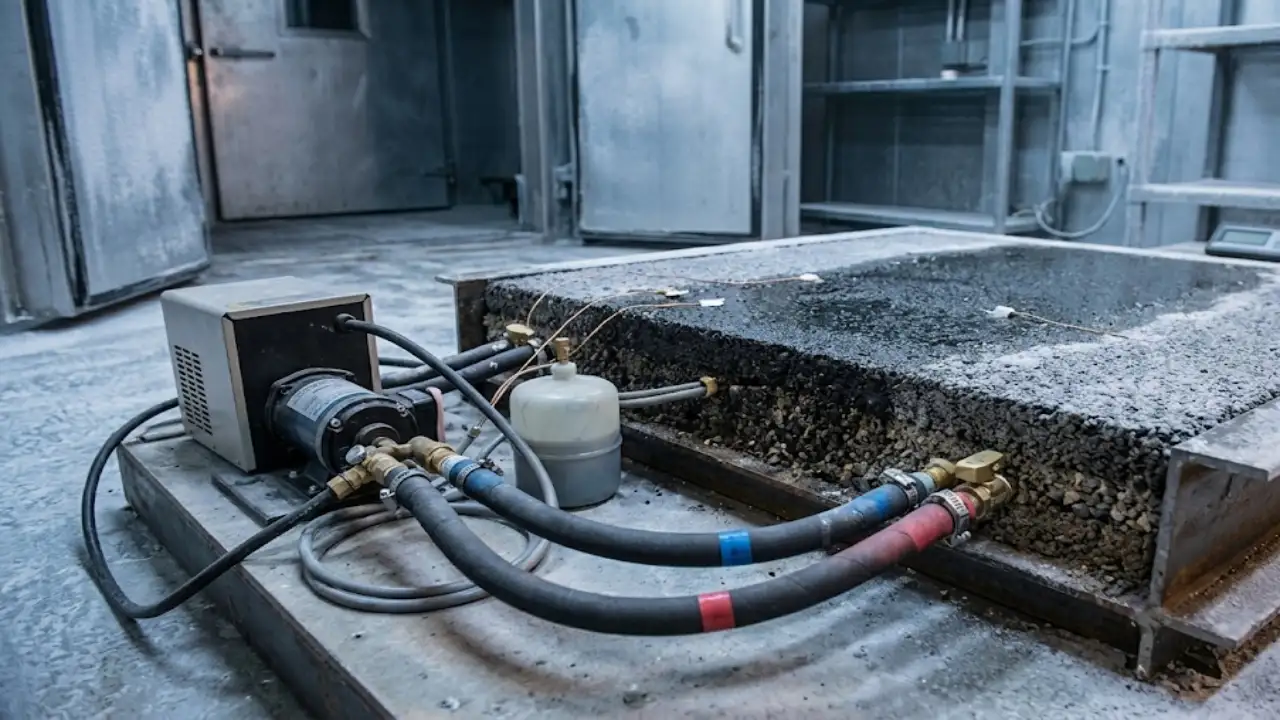
AI-generated representative image showing a laboratory pavement section kept above freezing by warm fluid circulating through buried tubing. Credits – Gemini
The loops provided enough heat to keep the surface ice-free, although a considerable share of the heat leaked downward, according to the team’s final report , published in April 2018 and archived by the National Transportation Library. One was tested by researchers at Stony Brook University, in collaboration with partners at Columbia University and Cornell University. They built a small section of pavement with loops of warm fluid buried in the gravel base layer under the asphalt and tested it in a freeze chamber.
To test the thermal side, the researchers built a stretch of pavement inside an insulated wooden box about 600 millimetres square, according to the report. From the top down it had 100 millimetres of asphalt, 150 millimetres of base, 150 millimetres of subbase and 300 millimetres of subgrade. A heating device pushed a 50-50 water and propylene glycol mix through it at 31.5 degrees Celsius, which is a warm bath, not anything scalding. The freeze chamber was held at minus 10 degrees Celsius for 48 hours before the fluid was started, by which time the surface had settled at about minus 7. Credits – Gemini The report says about 58% of the heat went up and 42% went down into the earth. In New York City, preventing every freezing event would have required 170 watts per metre of loop. The report recommends capping it at 100 watts per metre, which still raised the lowest predicted winter surface temperature in New York City from about minus 12.5 to about minus 6 degrees Celsius.
The Netherlands built a system that circulated geothermal fluid through loops in the asphalt layer, and it kept surfaces ice-free through the winter, the report says. Heated pavement is not a new concept. But the Dutch design needed a specially formulated crack-resistant asphalt mix and a plastic geogrid to stop stress around the loops from cracking the surface. That pushed up costs and limited its adoption in the US. A single W-shaped loop ran through the middle of the base. AI-generated representative image showing the warm-fluid circulation system and layered pavement specimen used to test an experimental heated-road design. The authors propose an insulating layer under the loops to drive more heat to the surface. They then modelled the design for Buffalo, New York City and Washington, DC.