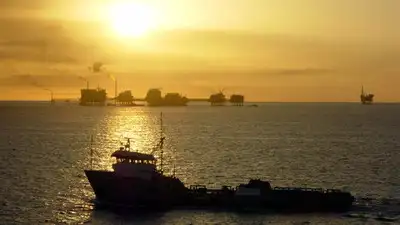
Gulf of Mexico. Image credits: Wikimedia Commons
In a 2014 paper in the Proceedings of the National Academy of Sciences , Jeremy Claisse of Occidental College and colleagues reported that California oil platforms had the highest secondary fish production per unit of seafloor area of any marine habitat studied to date, about an order of magnitude higher than other marine ecosystems, including estuaries, traditionally considered among the most productive on the planet. The researchers analyzed four Southern California platforms using hydroacoustics and trawls over 18 months, then converted the fish biomass they measured into standing stock and annual production per square meter of seafloor. Drawing on separate visual surveys of 16 platforms conducted over as long as 15 years by co-authors Milton Love and Ann Bull, the team estimated that platform fish communities produced roughly ten times more biomass than other marine habitats studied, with the platforms’ midwater structure accounting for most of that production; the researchers attributed this largely to rockfish larvae settling and maturing on the platforms’ hard vertical surfaces. The same paper found that, compared specifically to nearby natural rocky reefs at similar depths, the platforms produced more than 27 times as much fish biomass. It was determined through the use of mobile acoustic sampling that there was five times less biomass and fish density at 10 metres and 16 times less at 30 metres from the reef structure. In combination, these two studies account for the biological principle behind BSEE’s estimate of 43 platforms.
The study conducted by Kevin Boswell et al. investigated Freeport Sulphur Mine Artificial Reef, a platform turned into an artificial reef off the coast of Louisiana, which was the biggest reef structure in the northern Gulf of Mexico at the time, according to the Bulletin of Marine Science. California research measured record fish production on platform structures The reasons behind their effectiveness are not only anecdotal. This finding inevitably led to a natural inquiry: Is this true for the Gulf of Mexico, which has many more platforms than the California coast? The Bulletin of Marine Science research also found that fish concentrated most heavily near the bottom of the water column rather than near the surface, a pattern that has practical implications for how platforms are toppled or partially removed during conversion. As the research above suggests, the platforms’ complex structure, not simple attraction, appears to be what drives the high fish production observed around them.