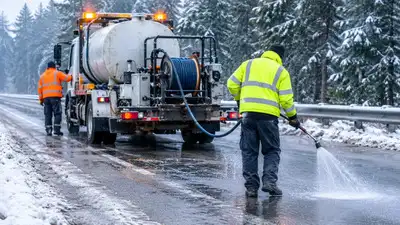
Representative AI image of road maintenance workers applying liquid de-icer to an icy highway using specialised spraying equipment during winter conditions. Image Credits: ChatGPT.
But Oregon Highway managers considered a different approach to wintertime highway treatment in a test from 1993 to 1995. The compound was tested at 21 sites and could offer a cheaper alternative to conventional winter road treatment. The solution was supposed to keep the ice from fusing to the pavement, therefore allowing highway crews to more easily plough the ice off the roads after the winter storm stopped.
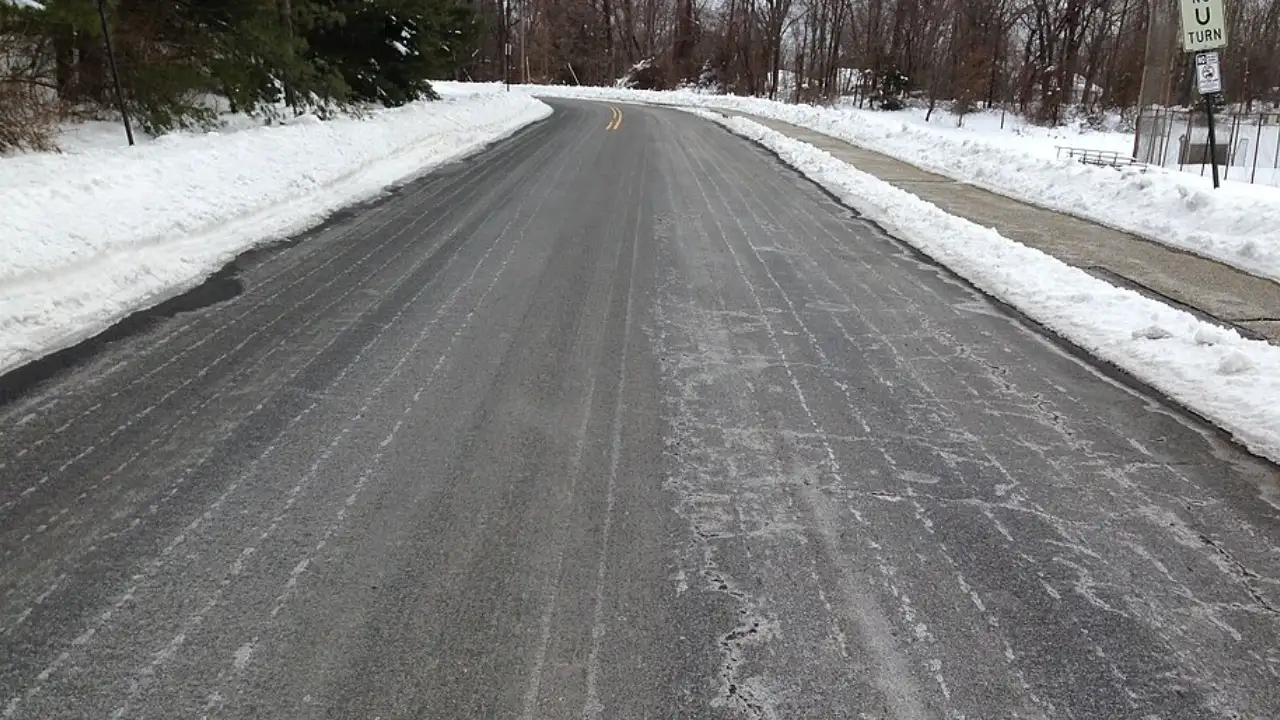
A hazard of frozen precipitation on highways has long bedevilled highway maintenance crews, especially in areas where a sudden plunging temperature can turn a wet highway into a sheet of ice. Some of the sediment also contributes to water pollution, and many of the trucks and machinery that applied the sand created dust problems for adjacent residences.
Instead of using mostly sand to coat icy roads, highway crews pretreated roads with liquid magnesium chloride before the snow and ice arrived.
A study published in Transportation Safety and Environment found that chemical de-icers significantly impact the environment. Researchers pointed out the importance of protecting sensitive aquatic systems and also evaluating the impact of chemicals after they have been deposited on the landscape. Oregon learned that winter road maintenance does not need to start only when the pavement is covered with ice. Using a pre- treatment strategy, highway crews could eliminate the need for sand, reduce cleanup, and minimise treatment expenses. The experiment helped validate the use of a preventive road treatment strategy.
During the winter of 1993-1994, Oregon DOT experimented with anti-icing strategies at 21 check sites in nine districts. The test extended into the winter of 1994-1995. In 1996, the FHWA published a manual of practice for an effective anti-icing program after analysing the 1993-1995 winter seasons in 15 participating states.
The sites chosen ranged from city streets to mountain passes and rural roadways with minimal traffic. The range of sites let officials observe how the strategies performed under different conditions. Two different liquid chemicals were tested in the experiment. One notable aspect of the experiment was the impact of liquid magnesium chloride when it was applied prior to freezing rain. a few roads were salted beforehand to discourage the hardened precipitation from sticking to the pavement While crews normally wait for ice to form. The technique was part of a broader move toward pre-treating highways for winter maintenance. The manual emphasised the need for weather information to determine the appropriate level of chemical to be applied and the need for maintenance personnel to be ready to take action. It also explained that certain types of weather were more appropriate for liquid treatment, depending on pavement temperature, the amount of precipitation, and the possibility of the chemical being diluted or washed off.