
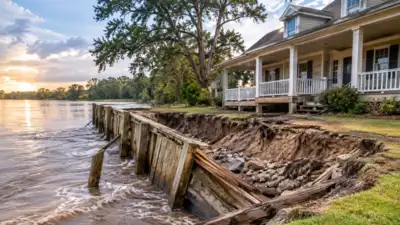
Representative Image (AI-generated)
The Louisiana Court of Appeal, Third Circuit, addressed the dispute in its October 30, 2026, decision in Elizabeth D. It ultimately removed the homeowner’s share of responsibility, increased her mental anguish compensation and revised the damages awarded, bringing her total recovery to $448,431.34. In March 2018, Molbert filed a damages lawsuit against Kenko and its insurer, Travelers Property Casualty Company of America. They ruled that Travelers’ policy excluded the $167,058.59 cost of repairing and replacing the defective bulkhead itself. Thus, although Molbert’s total damages award increased to $448,431.34, Travelers’ coverage did not extend to the entire amount. The court also rejected Kenko’s argument that the homeowner’s $165,000 flood insurance payment should be deducted from her recovery.
Because the dispute arose from the agreement to construct the bulkhead, the insurer argued that the policy’s breach-of-contract exclusion applied. Because kenko did not hold the required licences to perform the contracted work, however, the appeals court found that the exclusion did not prevent coverage. Because it involved damage to other property after the construction work had been completed, however, the damage to Molbert’s house was covered under the policy’s products-completed operations hazard provision.
Molbert v. Kenko Bulkhead & Marine Services, LLC, et al., available on Justia. The court examined the contractor’s responsibility for the failed construction, the homeowner’s share of fault and the extent of the contractor’s insurance coverage. She alleged that defective construction of the bulkhead had caused the damage to her property. She later amended her lawsuit to include Kenko’s owners, Kenneth Cooley and Glenn Beier. Among her allegations was that the two men had assured her they were licensed contractors and legally qualified to perform the work, although they did not have the required licences. Under Louisiana law, a construction contract entered into in violation of licensing requirements can be considered an absolute nullity. The judges also examined the policy’s work-product exclusion. The court also clarified that the jury’s award under the combined ‘shoreline/bulkhead’ category represented bulkhead replacement costs alone, as Molbert had not restored the shoreline. The policy did not cover the mental anguish award, a finding by the trial court that remained undisturbed on appeal. It explained that Molbert remained entitled to pursue the unpaid portion of her damages, although she would have to reimburse Liberty Mutual in accordance with the policy’s subrogation clause.
A central issue before the appeals court was whether Travelers could avoid covering the damages under exclusions in its commercial general liability policy.
The case went to a jury trial in September 2024. The jury assigned 75% of the responsibility for the damages to Kenko, Cooley and Beier collectively, while finding Molbert 25% at fault. It awarded her $266,372.75 for damage to the house, $167,058.59 for the bulkhead and shoreline, $2,500 for loss of enjoyment of life and $7,500 for mental anguish. After reducing the award to account for her 25% share of fault, her recovery was calculated at $332,573.50.
The trial court subsequently dismissed the claims against Cooley and Beier in their individual capacities. The homeowner, contractor and insurer all appealed.