
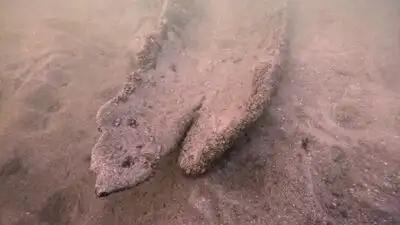
Wisconsin diver finds 17-foot canoe underwater, radiocarbon dating puts it at 1,000 years (Image Credit: Wisconsin Historical Society)
Jon Greendeer, president of the Ho-Chunk Nation, told WPR that the discovery falls within Ho-Chunk territory and that he was excited by the find. He also said that finding canoes and other Indigenous artifacts in the area was not unexpected. Greendeer described canoe construction as a labour-intensive process, noting that the vessels were crafted by carving wood using fire and other tools.
The results indicated a 70% probability that the canoe was in use between A.D. 992 and 1049, placing it roughly 1,000 years ago. Because he had previously worked with Tamara Thomsen, a maritime archaeologist with the Wisconsin Historical Society who has studied ancient canoes in Wisconsin, schachtner recognised it as a dugout canoe.
Schachtner told Wisconsin Public Radio (WPR) that the canoe was the oldest human-made object he had ever found. Thomsen described the discovery to WPR as a “beautiful find” and noted that the canoe remained intact on the lake bottom. Thomsen told WPR that char marks were visible on its underside, while scraping marks appeared consistent with shaping using stone tools or shells.
Within days of the discovery, Thomsen joined Schachtner at the site. She and the team recorded measurements, photographs and video and collected wood samples for further analysis. The wood was identified as white oak by Michael Wiemann at the U.S. Department of Agriculture’s Forest Products Laboratory in Madison. A sample was then analysed by Beta Analytic, a radiocarbon-dating laboratory in Miami. The period corresponds to Wisconsin’s Late Woodland period. Researchers also found evidence of how the canoe was made. The findings offer clues about the methods used by Indigenous canoe makers during the period.
He had previously discovered a fossil while diving in another lake, but the canoe represented an entirely different kind of find. The species is also found in several other ancient canoes previously documented in Lake Mendota.
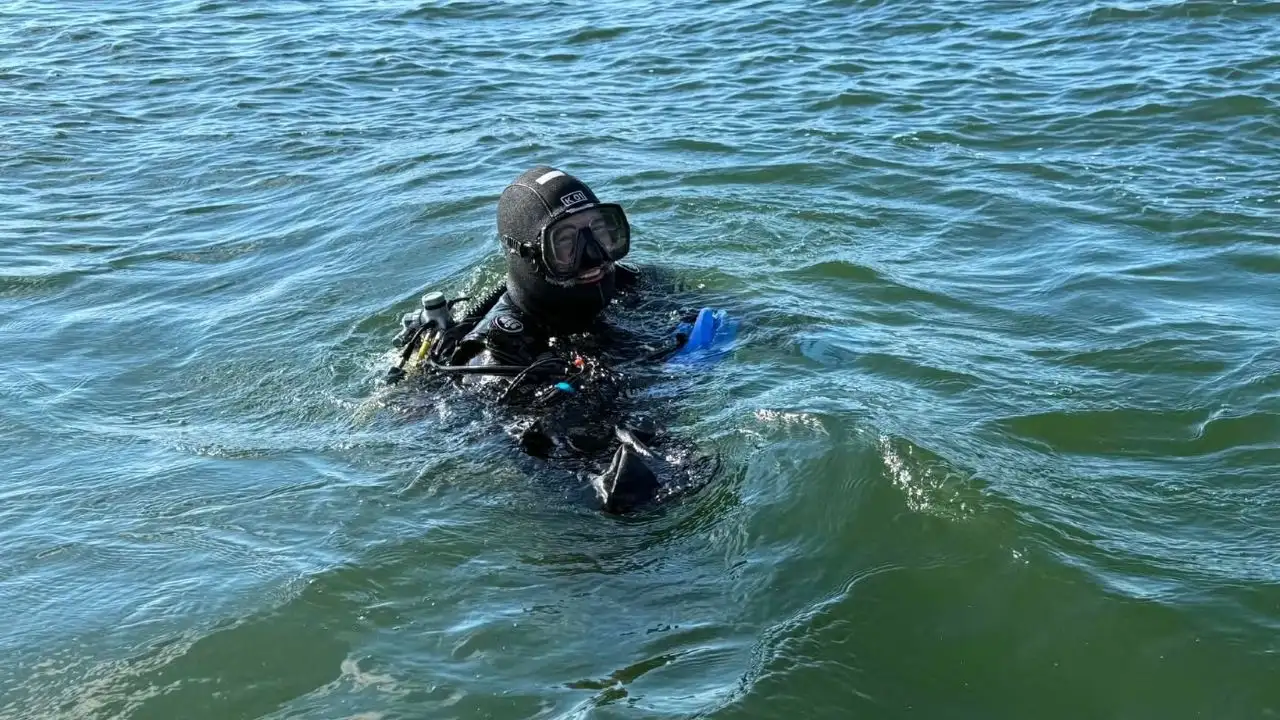
Canoe will remain underwater
Mark Schachtner, a diver from Beaver Dam, spotted a partially buried 17-foot dugout canoe while exploring Pewaukee Lake in May. Radiocarbon dating has since established that the vessel is about 1,000 years old. State archaeologists and volunteers have examined 88 out of 130 known vessels on lake bottoms and within collections across the state, said Thomsen. Thomsen said Wisconsin has half of the top 10 oldest canoes in eastern North America.
The canoe dates to the Late Woodland period and is made of white oak, according to the Wisconsin Historical Society. Another canoe was discovered and removed from the lake in the 1930s, according to Thomsen’s research into historical newspaper accounts. An ordinary dive in search of old bottles has led to an extraordinary archaeological discovery beneath a Wisconsin lake. The Society is consulting with Native Nations and archaeological experts to document the discovery, while the canoe will remain submerged rather than being removed from the lake. The discovery adds to Wisconsin’s growing record of ancient dugout canoes. The Pewaukee Lake canoe is actually the second ancient canoe known to have been found there.