
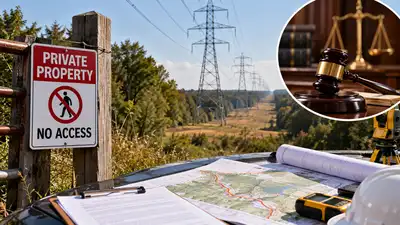
Image AI generated
A US appeals court has upheld an order allowing PSEG Renewable Transmission LLC to access private properties in Maryland to conduct surveys for its proposed 67-mile Maryland Piedmont Reliability Project, despite opposition from landowners and pending state approval. The Arentz Family and 116 other property owners refused access, according to the Fourth Circuit. The dispute involved the Arentz Family and 116 other defendant-appellants who refused to allow PSEG onto their properties.
Because required field studies had not been completed, the project’s application for a Certificate of Public Convenience and Necessity remained administratively incomplete. The court backed survey access before final approval, while the Maryland Public Service Commission’s review of the project remained ongoing. The court record states that the affected land included multi-generational farms, properties subject to forest and wetland conservation easements, and land used for commercial businesses. PSEG sought access to carry out surveys needed to assess the project’s environmental and socioeconomic effects and support its application for state approval.
In March 2025, the PPRP reported that it lacked sufficient information to determine whether the application was complete. The court record states that the PPRP estimated it would take approximately 30 months to assess a CPCN application after filing. Because it could not access the properties, but the programme said those studies could not be verified and that field studies were necessary, pSEG had submitted desktop studies based on secondary sources.
The application was consequently classified as “administratively incomplete”.