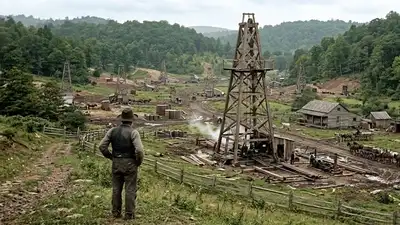
AI-generated representative image showing a nineteenth-century Pennsylvania farm overlooking an emerging oilfield with wooden drilling derricks. Credits – Gemini
Edwin Drake’s well near Titusville in August 1859 helped establish commercial oil drilling in the region. McCray, who had bought a farm in 1850, became one of the landowners whose fortunes were transformed by the oil boom. McLaurin’s historical account describes McCray as the son of a farmer, born in 1824 near Titusville. At 22, McCray set out on his own with two dollars in his pocket and spent three years working at a sawmill on the Allegheny River. By 1850, he had saved enough to buy a team and begin farming. His property later became part of the oil boom that followed Drake’s 1859 discovery.
Farmers who leased their land were among the first to benefit from the oil boom, according to the American Oil and Gas Historical Society . The discovery changed the value of nearby land as operators began searching for productive ground. James S. Its history of early wells along Oil Creek describes how the valley and surrounding hillsides were rapidly leased or purchased as operators sought promising drilling sites. McCray’s farm stood on a bluff just east of Petroleum Centre, close to the developing oilfield. From pay at the mill to farm John J. McCray’s first oil venture involved selling an interest in a lease to raise money for further drilling. Selling a lease to drill a well
Before the oil boom, farmers in Pennsylvania’s Oil Creek valley relied on crops and livestock, and the surrounding hillsides could be difficult to farm.
McCray faced different risks when holding land and storing oil. The value of his property depended on the productivity of the wells and the demand for leases, while stored crude could lose value through leakage, evaporation, taxes and falling prices. His decision to hold the oil in anticipation of a higher price left him exposed when the market moved in the opposite direction. By the time McLaurin published his account in the 1890s, Petroleum Centre’s oil boom had become part of the region’s past. McCray’s experience illustrates how drilling could transform the value of a farm, while holding crude for a better price exposed landowners to storage costs and a volatile market. As the wells declined, the productive land that had once attracted intense interest eventually returned to pasture. You use AI every day. Now get your AI Quotient. Take the AIQ test.
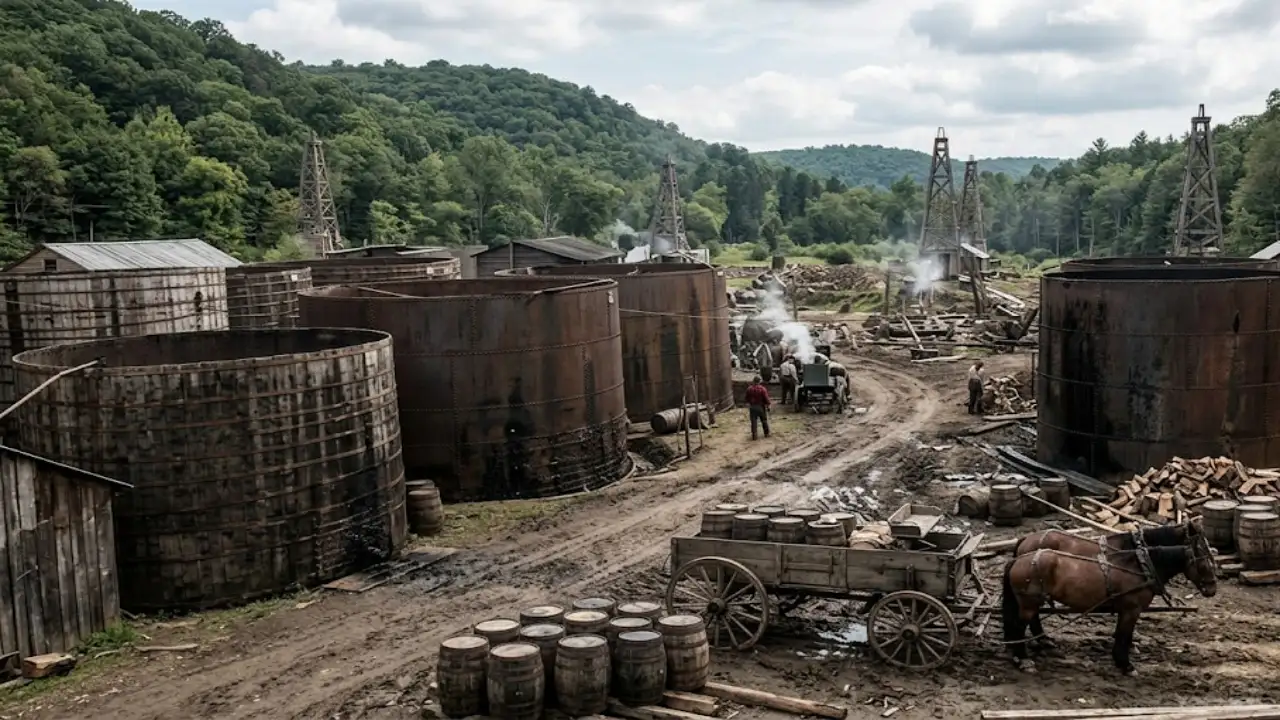
McLaurin reported that this venture brought McCray $70,000. McLaurin reported that McCray turned down an offer of $500,000 for his 80 acres in 1865. The 1865 offer came after commercial oil drilling had already begun in the region. Credits – Gemini Saying no to $1 million Interest in Petroleum Centre revived in 1870 when Jonathan Watson drilled a productive well on the nearby Dalzell farm, close to the southern boundary of McCray’s property. McLaurin reported that prospective lessees were offering a bonus of $1,000 per acre plus half the oil produced, but McCray could not meet even a tenth of the demand. In 1871, he reportedly refused an offer of $1 million for his farm. The Venango Museum’s history of the 1870 oil boom describes how Watson’s well renewed interest around Petroleum Centre. In 1871, when prices were around $3 a barrel, he reportedly refused to sell below $5. McLaurin recorded that McCray bought, hired and built iron tanks to store about 200,000 barrels while waiting for higher prices. He declined offers of $4, $4.50 and $5 a barrel before eventually selling most of the oil for about $1 to $2 a barrel.
McLaurin’s account says McCray’s first oil venture was a share in a two-acre lease at Rouseville. He sold that interest to finance a well on the nearby Blood farm, alongside his own property. His account, Sketches in Crude Oil, is a historical work about the early petroleum industry rather than a novel. A lease was merely the right to drill for a fee. In the 1860s leases changed hands nearly as if they were shares. Selling one to pay for another was an early method of raising capital, and it was risky: a dry hole would have left him with nothing. It also meant McCray learned how the money flowed before he had to make a decision on what to do with his property. Friends reportedly regretted the decision for years. A well drilled on the top of the hill was too shallow to reach the oil-bearing layer and was thought to be dry, delaying further development there for about five years. AI-generated representative image showing iron oil storage tanks, wooden barrels and horse-drawn transport equipment in a nineteenth-century Pennsylvania oilfield. The strike renewed demand for leases on McCray’s own farm. These terms described leases, not offers to purchase the land. McCray’s decision to hold oil rather than sell it immediately carried a different set of risks. Leakage, evaporation and taxes reduced the value of the stock.