
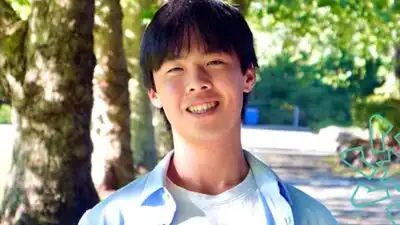
Khaos KookPhoto: davidsongifted.org
Meet Khaos Kook, an 18-year-old violinist from Shoreline, Washington, whose concussion and seizure in 2024 kept him from playing for more than six months and forced him to rethink what it means to be a musician. For this work, he was named a 2026 Davidson Fellow and awarded a $25,000 scholarship, one of the most prestigious honours for students 18 and under in the United States, according to the Davidson Institute and local reporting. Over the next 16 months, Kook explored multiple pathways for staying connected to music without relying solely on playing. He was also named a 2026 YoungArts Winner with Distinction in Classical Music and is a nationally recognised poet and essayist.
Because his work emerged from a period when he felt cut off from classical music, an integral part of his identity for more than a decade, he has described the award as especially meaningful. During his recovery, he turned his personal struggle into a structured, evidence-based return-to-instrument protocol for injured musicians, alongside a broader framework that defines musicianship through listening, research, teaching and advocacy as well as performance. In that period of forced stillness, Kook began asking a question that would become the core of his Davidson project: What makes someone a musician when they can no longer perform? He realised that classical music culture often equates musicianship with continuous physical performance and relentless practice, leaving little room for artists who are injured, disabled, aging or otherwise constrained. His own experience became a lens through which he examined this narrow definition and searched for a more inclusive model. He immersed himself in score study, historical research, scientific inquiry and deep listening, while also engaging in teaching, advocacy and community work. He gradually reintroduced physical practice and performance as his health allowed, but he treated these as just one part of a broader artistic life rather than the sole measure of his identity. Kook’s project goes beyond medical recovery. It challenges the assumption that musicianship is defined only by the ability to perform on an instrument. He proposes a broader framework in which sustained artistic, intellectual and social engagement all count as legitimate forms of musical life. In this model, an injured violinist who cannot yet play can still be a musician by studying scores, researching repertoire history, writing about music, teaching theory, advocating for hearing health or organising community concerts. For Kook, the fellowship is more than financial support. It is affirmation that adversity can be transformed into a powerful source of inquiry. The recognition validates his effort to turn a personal crisis into a contribution that can help others in similar situations. Kook’s background extends well beyond the concussion and recovery. He has studied at international music institutes including Heifetz, Keshet Eilon and Mozarteum’s ISA, and has been invited to solo with six professional orchestras across the United States and Europe. His interests span English and music, with plans to continue exploring across disciplines in college. Outside of music and research, he enjoys off-piste skiing, cheering for Tottenham Hotspur and spending time with his Goldendoodle and Aussie Shepherd. These details paint a picture of a teenager whose life is rich and varied, even as he navigates the demands of high-level artistry and academic work. They also underscore his belief that a musician’s identity can be multifaceted, rooted in more than just hours of practice and stage time. In a culture that often prizes constant productivity and visible achievement, Kook’s work is a reminder that rest, recovery and intellectual engagement are also part of a meaningful artistic life. By redefining what it means to be a musician, he is helping to create space for more diverse paths and longer, healthier careers in classical music.