
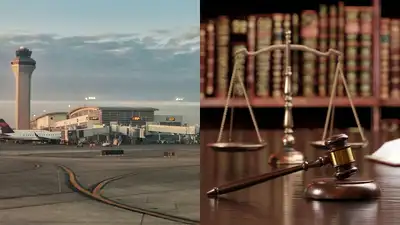
Court ruled overheight trees posed a public nuisance, making their removal non-compensable under property law.
natural beauty and a sense of isolation, property ownership near a major airport comes with restrictions that can reach well above ground level While a patch of woods can offer privacy. The height of trees on one Michigan homeowner’s property became the basis of a long legal battle against the authority that operates Detroit Metropolitan Wayne County Airport. Nearly three decades after buying the land, she suffered a major blow to her court battle when an appellate decision allowed the airport authority to enforce aviation safety restrictions.
A dispute over property with roots in aviation safety
Michelle Baldwin bought a wooded property in 1997 on Vining Road, south of Detroit Metropolitan Wayne County Airport, according to the Michigan Court of Appeals. The dispute began after the Joint Airport Zoning Commission for Wayne and Washtenaw Counties approved an airport zoning ordinance in July 2016. The rule established tree and structure height limitations within a 20-mile radius of the airport, and anything above the limits was considered a potential aviation hazard. Baldwin’s property was in Zone B, which meant that trees and other objects could only be up to 50 feet above the elevation of the airport. Airport contractors have conducted obstruction surveys around the airport in 2018, 2021 and 2022 to identify possible risks. The Michigan Court of Appeals affirmed the lower court’s decision in its November 3, 2026 ruling.
To the north was property owned by the Wayne County Airport Authority. The Michigan Court of Appeals pointed out that some trees on Baldwin’s property eventually grew taller than the prescribed height. The trial court ruled for the airport authority, holding that the maintenance of trees in excess of aviation safety restrictions constituted a public nuisance. The bottom line: removing the hazards was not a compensable taking of private property. A judges’ panel of a court of appeals ruled airport hazards were a public nuisance under state law and the authority had the authority to take steps to remedy the violation. They also denied Baldwin’s claim for compensation, finding the enforcement measures did not deprive her of the productive use of her multi-acre property.