
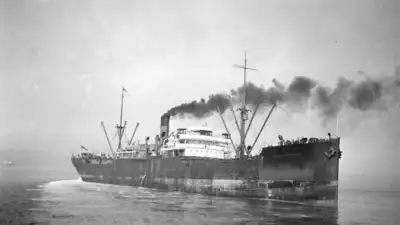
A German submarine secretly landed two Nazi spies on American soil in November 1944 before torpedoing a Canadian merchant ship off the coast of Maine just four days later, killing 43 people aboard. More than eight decades after the World War II tragedy, divers have finally located the long-lost vessel nearly 400 feet beneath the Atlantic Ocean. The discovery of the SS Cornwallis, reported by Smithsonian Magazine, has brought renewed attention to one of the lesser-known episodes of Nazi espionage along America’s eastern coastline.
The wreck was discovered on July 11, 2026, by the Nomad Exploration Team, a civilian technical diving group based in Portsmouth, New Hampshire. Using side-scan sonar, historical shipping records and the vessel’s original blueprints, the divers identified the wreck in approximately 400 feet of water. The discovery was formally announced in October, more than 81 years after the ship disappeared beneath the sea. The team said locating the vessel was not just an achievement in underwater exploration but also an opportunity to bring attention to the 43 people who lost their lives. The SS Cornwallis was a 5,458-ton steam merchant vessel built in Vancouver, British Columbia, in 1921. On September 11, 1942, the vessel was attacked by a German submarine while anchored in Barbados. In November 1944, it departed Barbados carrying sugar and molasses bound for Saint John, New Brunswick. There were 48 people aboard, including seven armed guards. On December 3, 1944, as the vessel travelled along the Maine coastline, German submarine U-1230 spotted it and launched a torpedo. The explosion struck near the forward cargo hold, causing the ship to sink by the bow in less than 10 minutes. Only five of the 48 people aboard survived. Colepaugh eventually had second thoughts about his involvement and turned himself in to the FBI on December 26, 1944. His cooperation helped investigators locate Gimpel, who was arrested in New York on December 30. It was only after the Cornwallis was torpedoed on December 3 that officials could suspect that the submarine responsible might also have been involved in landing German agents near Mount Desert. The search for the Cornwallis began in 2019, when the Nomad Exploration Team decided to locate what was considered one of the largest missing shipwrecks in New England waters. The divers eventually scanned more than 50 square miles of the ocean floor using side-scan sonar. During their July 2026 expedition, the team spotted a possible wreck on July 11, although it initially passed the location without recognising the vessel. The wreck lies nearly 400 feet underwater, where divers had to contend with extremely cold temperatures, powerful currents and difficult visibility. For the discovery team, the excitement of locating a missing World War II vessel was accompanied by the realisation that they were exploring the final resting place of 43 people.
Researchers identified three potential search areas based on where survivors were rescued, where debris had been reported and where a mariner claimed to have recovered the ship’s compass housing. A subsequent sonar scan revealed the ship’s outline.
Danny Allan, a founding member of the Nomad Exploration Team, told the Portland Press Herald that the discovery could bring renewed attention and a sense of closure to the families connected to the tragedy. The team has said it hopes to return to the site and use a remotely operated underwater vehicle to document the wreck and monitor its deterioration. The team had spent seven years searching for the missing ship before locating it near Mount Desert Rock in the Gulf of Maine. Originally named Canadian Transporter, it was later renamed Cornwallis after becoming part of Canadian National Steamships. Its wartime history was already unusual. The torpedoes severely damaged the ship, causing it to partially sink in shallow water. However, it was subsequently refloated, repaired and returned to service. Two years later, the Cornwallis was once again sailing through waters where German submarines posed a threat. Six initially managed to reach life rafts, but one subsequently died from hypothermia. The remaining survivors were eventually spotted and rescued by fishing boats before being transferred to a US Navy rescue vessel, which took them to Rockland, Maine. Both men were convicted of espionage and initially sentenced to death by a military court. Their sentences were later commuted by US President Harry Truman. The incident also demonstrated how close the German submarine campaign had come to the US mainland, even as the country was heavily involved in fighting the war overseas. The team studied historical records, examined archived blueprints and consulted maritime historians and local fishermen to narrow down the possible location. The divers then undertook deep-water expeditions to establish its identity, using the original blueprints to confirm that it was the Cornwallis. The confirmation was far from easy. Team members described the dives as some of the most challenging they had undertaken in their years of technical diving. The divers have also indicated that they do not intend to claim ownership of the vessel, describing the discovery itself and the opportunity to put the missing ship back on the map as their greatest reward. You use AI every day. Now get your AI Quotient. Take the AIQ test.
The U-1230, commanded by German naval officer Hans Hilbig, had arrived off the Maine coast with a secret intelligence mission just days before attacking the merchant vessel. On the night of November 29, 1944, the submarine entered Frenchman Bay and brought two German agents ashore near Crabtree Neck in Hancock, Maine. The two agents were Erich Gimpel, a 35-year-old German national, and William Curtis Colepaugh, a 26-year-old American-born Nazi sympathiser who had travelled to Germany and received espionage training. They had boarded the U-1230 in Germany and crossed the Atlantic before being dropped off on the Maine coastline. The submarine surfaced partially at around 10:30 pm and approached to within approximately 300 yards of the shore, according to the US Navy’s Eastern Sea Frontier War Diary. The agents reportedly carried approximately $60,000 in cash, diamonds, forged identification documents and secret inks.
Their mission, however, did not go according to plan. What makes the Cornwallis sinking particularly unusual is the identity of the submarine responsible. The operation was part of a Nazi espionage mission intended to gather intelligence about American industrial and technological capabilities. Two German sailors then used a rubber boat to transport the agents to land before returning to the submarine. The operation was carried out without the coastal authorities detecting the landing. The spies subsequently made their way towards Bangor, travelled by train to Portland and eventually reached New York City. Their assignment was to collect information about American industrial facilities and technological developments during the war.
Precautionary air patrols were conducted in the region during November 1944, but no enemy submarine was detected.
American authorities had anticipated that a German submarine might enter the Gulf of Maine, according to the US Navy’s wartime records. The connection between the spy landing and the Cornwallis attack became an important part of the subsequent investigation.